

Almost every quantum advantage experiment to date has been run by the team that built the processor, on their own hardware. That includes Google’s Sycamore and Willow, USTC’s Zuchongzhi, and Quantinuum’s H2. Outside researchers could read the papers but couldn't run the experiments themselves. We wanted to see whether that was still necessary.
In our new paper, we ran random-circuit sampling (RCS), the standard benchmark for quantum computational advantage, on IBM's Nighthawk r2 processor (ibm_phoenix). Nighthawk r2 is a commercial device available to anyone with an IBM Quantum account. We used the standard Qiskit cloud workflow, with no benchmark-specific calibration or special access.
The main numbers:
Everything is open source: every executed circuit, the qubit layout, the measured bitstrings (including the full million-sample run), and the code for circuit generation, fidelity estimation, and classical cost estimation.
As far as we know, this is the first demonstration of quantum advantage for standard random-circuit sampling on a commercially available processor by users outside the team that built it. The result also marks an important step toward IBM quantum advantage in 2026, showing that experiments previously limited to specialized research environments can now run on publicly accessible hardware.
In random-circuit sampling, you build a circuit from alternating layers of random single-qubit rotations and entangling gates, run it, and record the output bitstrings. After enough layers, a classical computer finds it extremely expensive to reproduce the output distribution.
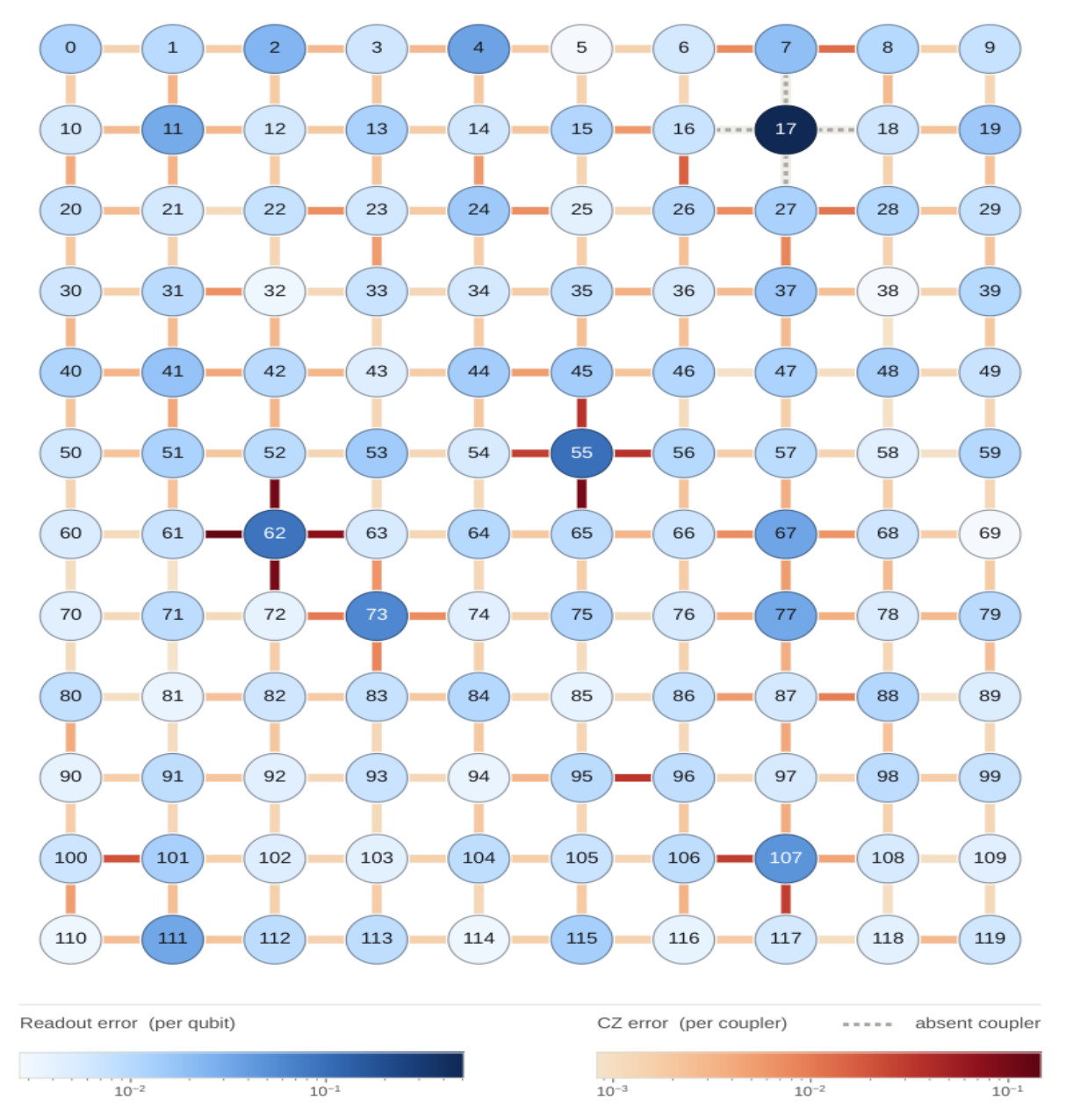
Earlier IBM chips used a heavy-hexagon layout. The IBM Nighthawk quantum processor instead arranges its 120 qubits on a 12 × 10 square lattice with tunable couplers between neighbors. Google's Sycamore and Willow and USTC's Zuchongzhi experiments used the same kind of 2D grid, so our circuits fit the hardware directly with no routing overhead. Immediately before the experiment, we scored every possible placement of an 8 × 8 grid on the chip using the latest calibration data. The best placement kept 61 qubits and 102 couplers.
At 36 cycles, computing a single ideal output amplitude of our circuit takes around 10²² complex operations, or roughly two days on Frontier. Checking a million samples directly is out of reach, so we estimated fidelity in two independent ways.
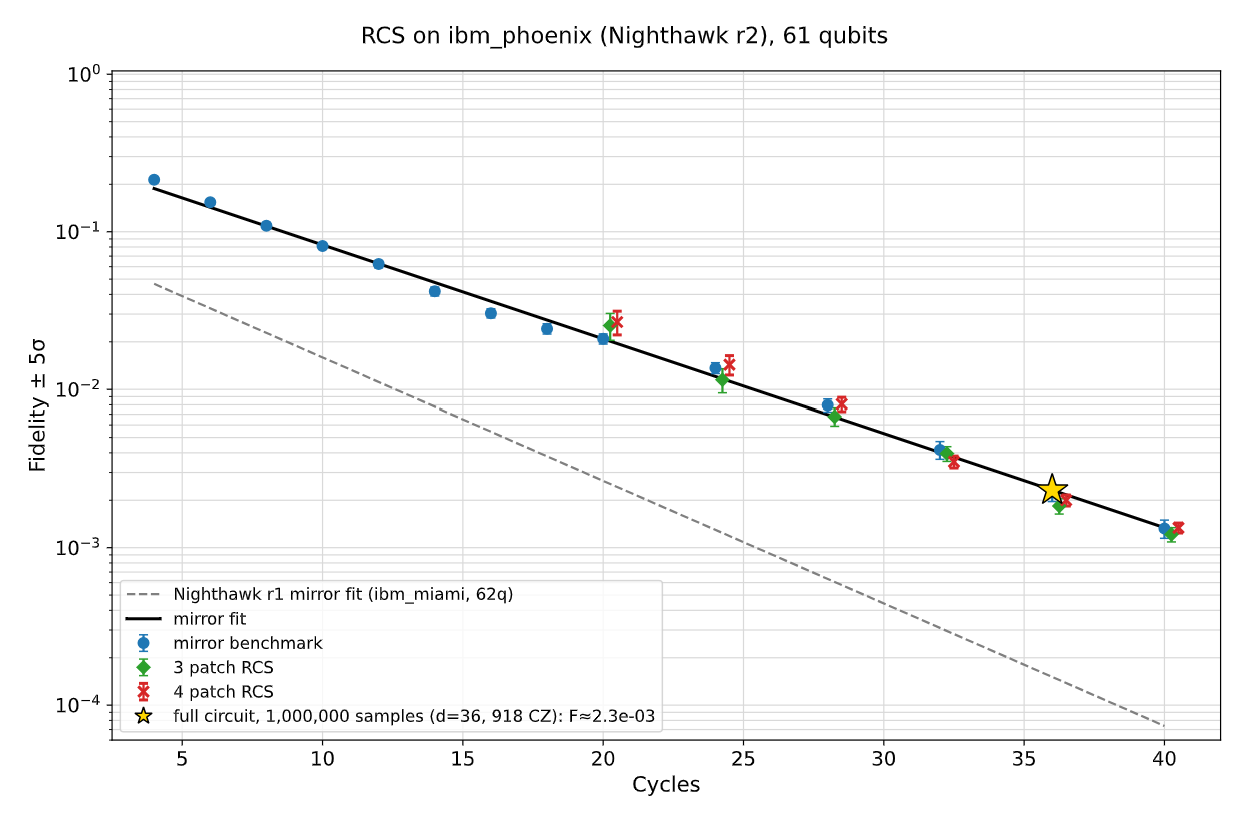
Mirror benchmarking runs a random circuit forward and then runs its exact inverse. On perfect hardware, you would recover the bitstring you started with, so the probability of getting it back gives a fidelity estimate without any classical simulation.
Patched cross-entropy benchmarking (XEB) splits the chip into 3 or 4 patches by removing the gates that cross patch boundaries. Each patch is small enough to simulate exactly, and multiplying the patch fidelities estimates the full circuit.
The two methods rely on different assumptions, and they agree at every depth we measured, across more than two orders of magnitude of fidelity decay. At 36 cycles, the fitted fidelity is F ≈ 2.3 × 10⁻³, with the mirror and patched-XEB measurements between 1.8 and 2.2 × 10⁻³. Compared with our earlier run on the first-generation IBM Nighthawk r1 (ibm_miami), per-cycle fidelity went from 0.836 to 0.872, and circuit fidelity at fixed depth improved by more than an order of magnitude. Runs that needed hours of QPU time on r1 now finish in minutes on r2.
Classical simulation of random circuits usually relies on tensor-network contraction. Its cost grows exponentially with circuit depth until the tensors reach the full size of the system, and then it levels off. For our circuits, it plateaus at around 10²² operations at 36 cycles. Fidelity keeps dropping with depth, so the classical task is hardest right where the contraction cost levels off:
Past 36 cycles, lower fidelity means a classical spoofer needs to match a weaker signal, so the task gets easier.
We tested our estimator on the tensor networks published from Google's Sycamore experiments. Across all five circuits, it came within a factor of 5 of the actual values. On Sycamore-67 at 32 cycles, the circuit most similar to ours, it came within 2%.
We also gave the classical side unlimited memory and negligible communication cost. We priced faithful sampling, which is harder than producing bitstrings that only match the benchmark score. We also tested severing attacks, which cut the circuit along a weak spot in the qubit graph and simulate each piece independently. None of the cheapest cuts on our coupler graph reached the experimental score. The best one fell short by a factor of ten, and balanced cuts fell short by six orders of magnitude or more.
Some classical methods could still lower the cost, including multi-amplitude contraction, approximate tensor networks, and finite-fidelity MPS simulation. Past RCS experiments have seen their classical estimates decrease over time, and we expect the same here. Publishing everything is how we invite those attempts.
The full experiment used about 11 minutes of QPU time. That includes both fidelity estimators at every depth from 4 to 40 cycles and the 19-second million-sample run. Everything ran through Qiskit Runtime batch execution on a public IBM backend.
Because IBM Quantum Nighthawk is accessible through the cloud, researchers can reproduce the experiment without owning or operating quantum hardware. With access to Nighthawk r2 and our repository, you can pull the exact circuits (in QPY and OpenQASM 3), run them on the same hardware, recompute the fidelity estimates, and rerun the classical cost analysis.
Code and data: github.com/BlueQubitDev/rcs-nighthawk
IBM has said publicly that it aims to demonstrate quantum advantage by the end of 2026, and that it wants those claims tested by the wider community. Our IBM Nighthawk experiment contributes to the broader IBM quantum advantage 2026 effort by demonstrating that current hardware can reach the regime of major published advantage experiments through a standard cloud service.
It complements our work on peaked circuits, which addresses RCS's main weakness: verification. Both lines of work reach the same conclusion: current quantum hardware can run computations that classical computers can't practically reproduce.
A quantum computer only provides commercial value where classical computers can't keep up, so demonstrating classical hardness has to come first. An advantage that only exists on one lab's private processor is hard to build on. An advantage available through the cloud gives other teams something to work from.
The move from r1 to r2 shows how quickly this is changing. One hardware generation brought more than a 10x improvement in circuit fidelity at fixed depth, better resistance to spoofing, and runtimes that dropped from hours to minutes.
For IBM quantum advantage research, that combination of improved hardware performance and public accessibility makes independent testing much more practical. The circuits and data are public. If you have access to a supercomputer and a faster classical algorithm, we'd like to see your results.
The paper "Quantum computational advantage in random-circuit sampling on IBM superconducting quantum computers" is available on arXiv at 2609.28657.


