
Viva Las Vegas!BlueQubit's first trip to DEF CON
BlueQubit attended DEF CON 34 for the first time last weekend, and the Quantum Village turned out to be a gold mine for quantum computing conversations. Amid thousands of hackers, security researchers, and tech pioneers taking over Las Vegas, post-quantum cryptography(PQC), quantum key distribution, and threat modeling against future quantum decryption were among the hottest topics on the cybersecurity radar.
Inside the Quantum Village
Stepping off the neon strip into the Quantum Village felt like walking into the vibrant heart of the event. Attendees crowded an arcade machine powered by a Quantum Random Number Generator (QRNG), while nearby, colorful physical qubit models from Quolor brought abstract math into tangible space. Between the hacking villages, the hardware capture-the-flag, and the deep-dive sessions, the discourse ran from high-level security policy on one end to hardware constraints on the other.
Post-Quantum Cryptography and the Q-Day Threat
Konstantinos Karagiannis — Senior Director of Quantum Computing Services at Protiviti and host of The Post-Quantum World podcast — sounded the alarm on "Q-Day," the moment a Cryptographically Relevant Quantum Computer(CRQC) becomes capable of breaking foundational public-key algorithms like RSA and ECC. He underscored the immediate danger of "Harvest Now, DecryptLater" (HNDL) and "Harvest Now, Forge Later" (HNFL) attacks,where adversaries steal encrypted data and digital signatures today tocompromise them later.
Karagiannis gave us a wake-up call: if migrating legacy systems takes longer than the window until Q-Day, organizations are already vulnerable. He also teased a forthcoming book on the topic, due out in 2027 — one we'll be eagerly watching for.
John Martinis on the Road to Fault-Tolerant Quantum Computing
Where Karagiannis warned of a ticking clock, John Martinis offered a counterweight. The 2025 Nobel Laureate in Physics — recognized for his pioneering work on superconducting qubits — drew such a crowd that organizers ran out of headsets and seats. Dozens of us streamed the audio through our own earbuds, creating an intimate, hyper-focused silent disco of quantum hackers.
Martinis brought a pragmatic optimism grounded in hardware: quantum computers are on the horizon, but useful fault-tolerant systems still require overcoming immense physical challenges, from qubit error rates and connectivity limits to speed variations across hardware modalities.
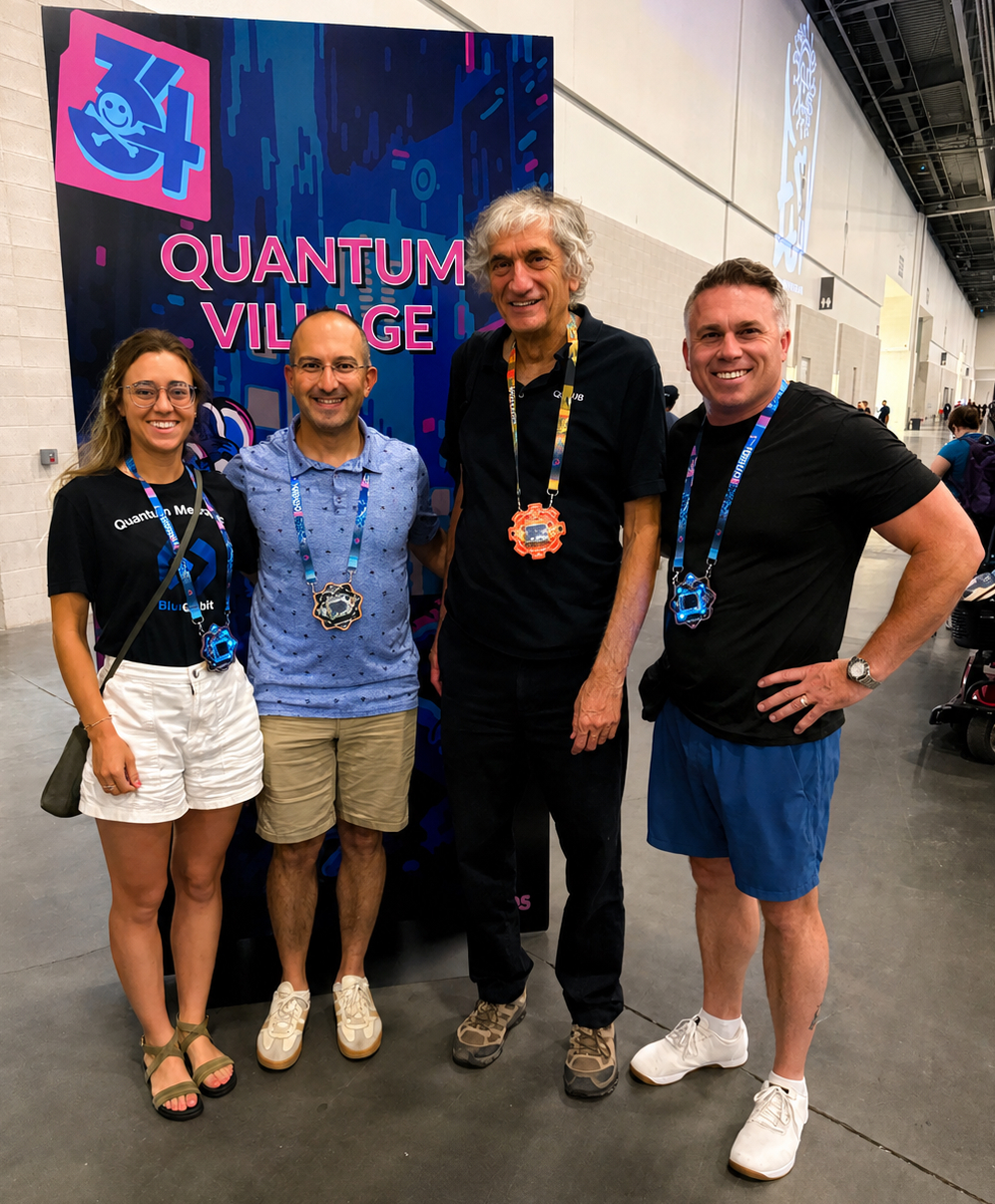
The message was clear: satisfying quantum hardware parameters demands deep patience and radical creativity. This challenge, Martinis argued, is an open invitation — quantum computing is not just for physicists, but for software engineers, computer scientists, security researchers, mathematicians, and curious minds of all disciplines.
BlueQubit And the Software Layer
When the audience reached for the microphones, their most pressing questions were about the missing middle layer: software and algorithms. Attendees were hungry to understand quantum compilation, noise mitigation, and hybrid classical-quantum execution. Developers and security researchers don't want to wait decades for fault-tolerant hardware— they want tools to write code, design algorithms, and run simulations today.
That's precisely where BlueQubit steps in. We hope to bridge the gap, bringing GPU-accelerated quantum simulation, algorithmic development toolkits, and hands-on software workshops straight to the Quantum Village stage.
We walked away from Las Vegas energized and inspired — and we can't wait to come back to DEF CON to build the quantum future together.
About BlueQubit
BlueQubit is a quantum applications and algorithms company focused on achieving quantum advantage. We develop and test novel applications using state-of-the-art QPUs alongside advanced classical simulation infrastructure powered by NVIDIA GPUs.
Contacts
Amanda Gaggioli


