

Quantum advantage is reached when a quantum computer performs a specific computational task more accurately, cheaply, or efficiently than the best available classical method, and researchers can verify that the result is trustworthy.
That last part matters. Producing a result that a classical computer can't reproduce isn't enough. A credible quantum advantage claim also needs evidence that the quantum computation worked as intended.
That distinction has become especially important in 2026, as researchers move beyond demonstrations of raw quantum computational power toward results that can be independently tested, challenged, and validated.
<div>{{quantum-era-banner}}</div>
Researchers have now reported experiments that meet strong criteria for quantum advantage on specific computational tasks.
However, quantum advantage has not arrived as a general replacement for classical computing. The results demonstrated so far apply to carefully defined problems, and each new claim remains open to improved classical algorithms that may narrow or eliminate the advantage.
The path to this point has developed over several major milestones.
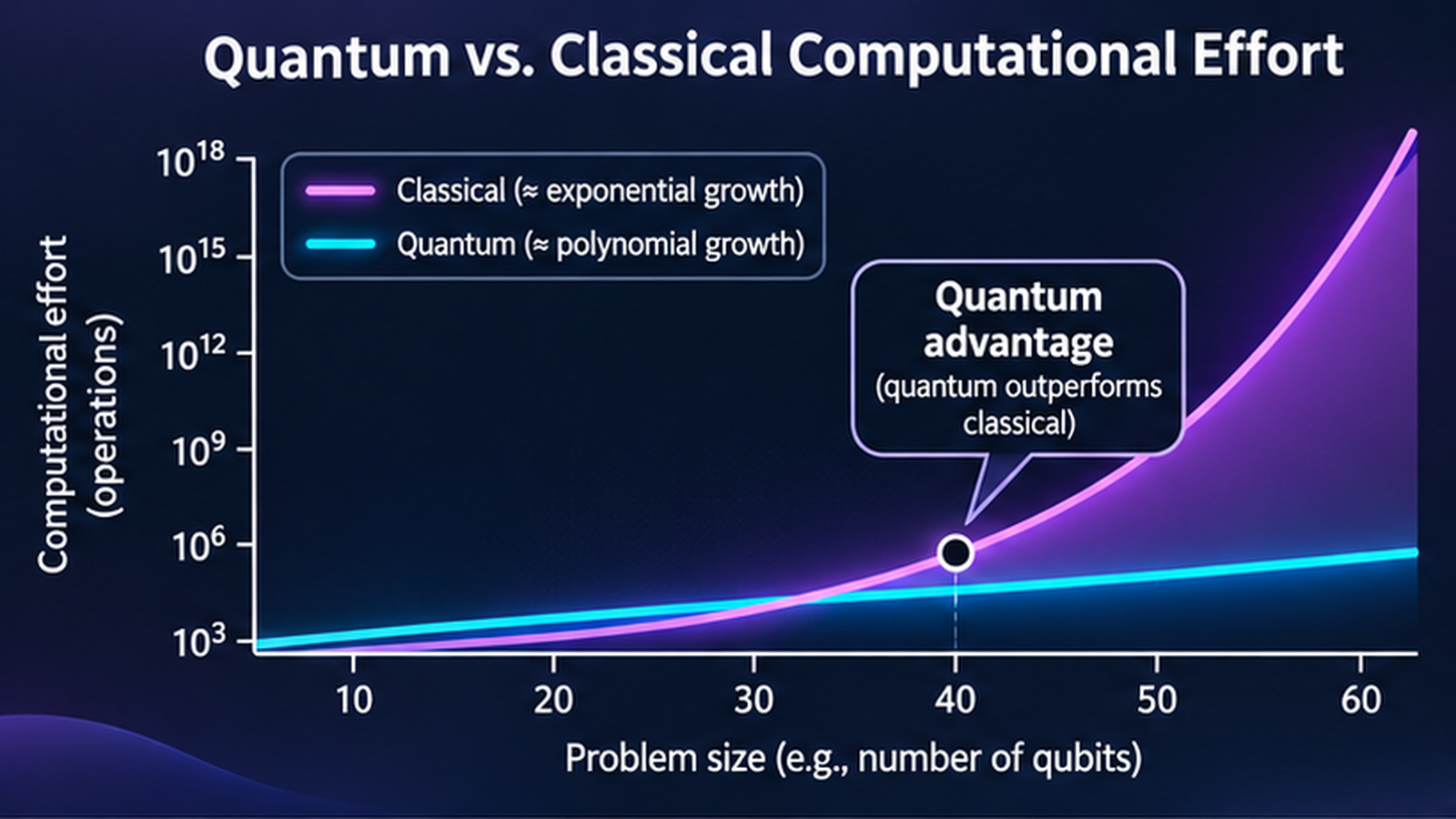
In 2019, Google reported that its 53-qubit Sycamore processor completed a random-circuit sampling task that would be impractical for the classical supercomputers available at the time.
The experiment became one of the best-known demonstrations of what was then commonly called quantum supremacy. The claim was immediately challenged. IBM argued that a sufficiently optimized classical supercomputer could perform the same calculation much faster than Google's estimate, reducing the proposed classical runtime from thousands of years to roughly days.
The episode established a pattern that still defines quantum advantage research today: a quantum team presents a computational result, and classical researchers try to reproduce or defeat it with increasingly sophisticated simulation techniques.
In 2023, IBM and UC Berkeley used IBM's 127-qubit Eagle processor to calculate expectation values for a quantum Ising model at scales beyond straightforward brute-force classical simulation.
Error mitigation allowed the quantum system to produce accurate results even when some of the classical approximation methods used in the original comparison began to fail.
IBM deliberately described this milestone as quantum utility, rather than definitive quantum advantage. The distinction was important. The quantum processor could perform reliable calculations beyond exact brute-force classical methods, but researchers had not yet established that it beat every competitive classical approximation method.
That caution proved justified. Classical researchers quickly reproduced the results with improved tensor-network and Pauli-propagation methods. Rather than invalidating the progress, this classical response illustrated why strong quantum advantage claims need continuous benchmarking.
By 2025, IBM and its partners were reporting several promising candidates for quantum advantage. Research groups were investigating problems involving:
IBM partners including Q-CTRL, Qedma, Algorithmiq, Qunova, and others reported cases where quantum approaches showed promising runtime, accuracy, or heuristic benefits.
At the same time, IBM maintained a stricter scientific definition: a quantum advantage claim should outperform the best-known classical alternatives and be rigorously validated.
This led to the Quantum Advantage Tracker, launched in November 2025 by IBM, the Flatiron Institute, BlueQubit, and Algorithmiq, where claims can be tested against new classical algorithms.
A major change came in July 2026. Several research collaborations announced experiments designed not simply to produce classically difficult quantum calculations, but to establish why the quantum answers could be trusted.
IBM and the University of Chicago, for example, demonstrated a computation using encoded logical circuits where the fidelity of the computation could be bounded even though directly reproducing the full result classically would be impractical.
A separate collaboration involving BlueQubit, Qedma, IBM, and RIKEN investigated quantum dynamics alongside demanding classical benchmarks. The methods and evidence behind that result are discussed in the BlueQubit research section below.
These experiments represent an important transition from asking:
Can a quantum computer perform something classically difficult?
to asking:
Can it perform something classically difficult while giving us rigorous reasons to trust the result?
Current status: Quantum advantage has been demonstrated for specific, carefully constructed tasks, but there is still no general quantum advantage across everyday commercial computing. Each claim remains subject to improved classical algorithms and independent validation.
Verification is one of the hardest problems in quantum computing. If a classical computer can reproduce a quantum result exactly, validating the quantum machine is straightforward. But once the quantum calculation becomes too difficult to simulate classically, the usual method of checking the answer disappears.
That creates an apparent paradox: how can researchers prove that a quantum computer solved something that classical computers cannot independently calculate? Several approaches are now used together.
Researchers first test smaller or simpler versions of a problem that both quantum and classical systems can solve. Agreement in this regime helps establish that the quantum workflow is operating correctly before researchers increase the problem size beyond exact classical simulation.
The strongest experiments also compare quantum hardware against several different classical techniques rather than a single benchmark.
Some quantum computations can be constructed so that errors leave detectable signatures. Researchers can then use syndrome measurements, statistical tests, fidelity bounds, or related methods to estimate how closely the hardware executed the intended computation.
This makes it possible to verify properties of the computational process even when reproducing the complete final answer classically is impractical.
A result becomes more convincing when different processors or hardware architectures produce compatible outcomes. The 2026 Qedma work, for example, compared results across IBM hardware and additional experiments on Quantinuum systems.
Agreement across different machines reduces the likelihood that an apparent discovery is simply an artifact of one processor's noise characteristics.
An important part of modern quantum advantage research is trying to disprove quantum advantage. Classical researchers use increasingly sophisticated simulation methods such as:
These techniques can sometimes reproduce circuits that initially appeared inaccessible to classical computers. BlueQubit's own Pauli-path simulators are built around this idea. A serious advantage claim should be tested against the strongest classical method available, not against an intentionally weak baseline.
If an improved simulator catches up with the quantum computer, the boundary moves. If classical methods keep failing while the quantum output remains verifiable, the advantage claim becomes stronger.
Another approach is to design tasks whose answers are difficult to discover but straightforward to check. Peaked circuits illustrate this principle: a candidate output can be checked against a designated high-probability bitstring. BlueQubit explores this approach in its research on verifiable quantum advantage with peaked circuits.
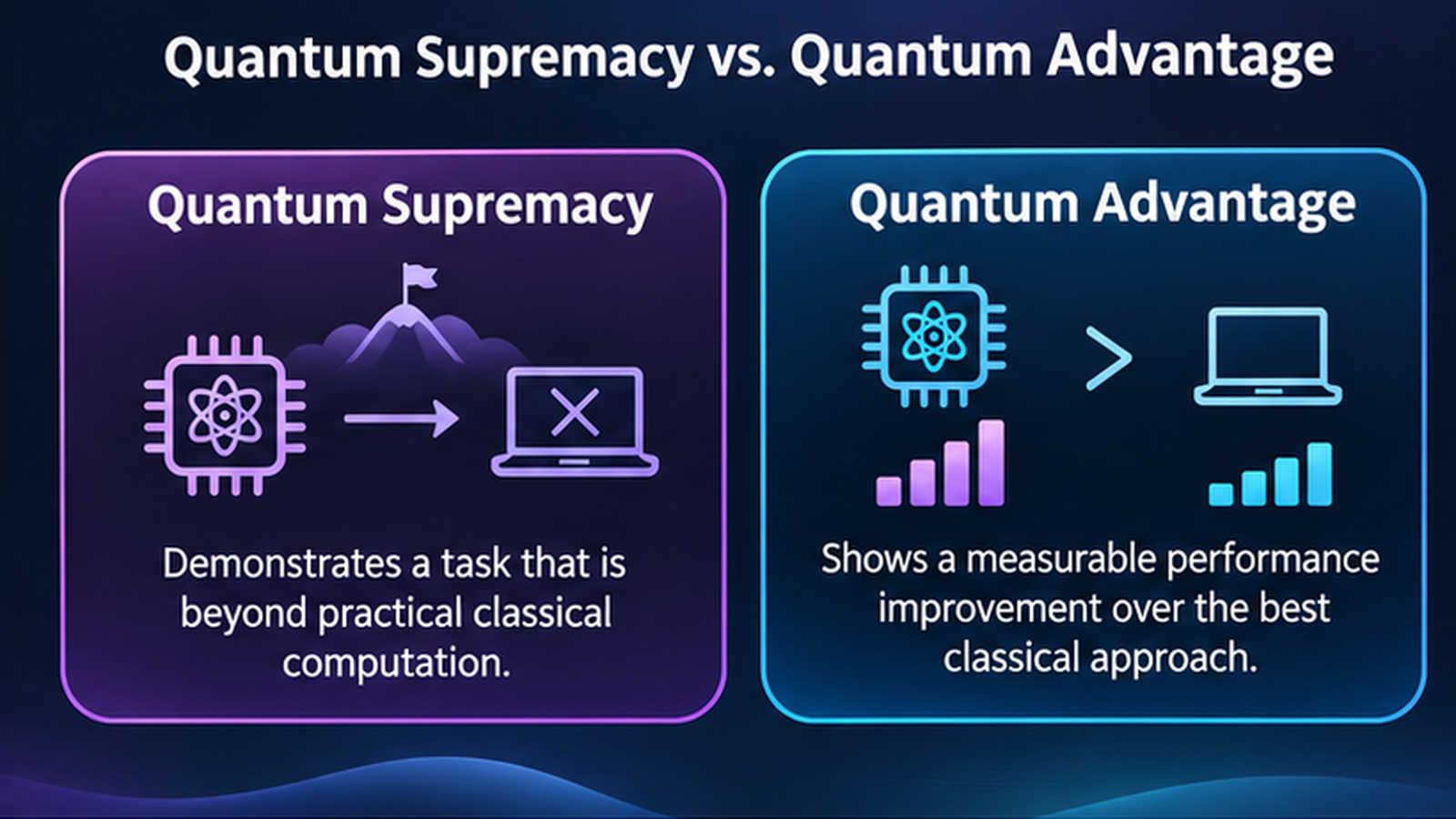
Quantum advantage and quantum supremacy are closely related, but they are not interchangeable. Google's 2019 Sycamore random-circuit sampling experiment is the classic example of a quantum supremacy claim: it aimed to show that a quantum processor could complete a task beyond practical classical computation at the time. As classical algorithms improved and challenged such benchmarks, researchers increasingly favored the term quantum advantage to emphasize comparisons with the strongest available classical methods rather than a single historical performance gap. The newer terminology also better accommodates questions about verification and whether a speedup matters for a specific task.
Quantum supremacy was primarily intended to demonstrate that programmable quantum hardware could enter computational regimes beyond classical machines.
Quantum advantage raises the bar. A convincing advantage result needs a fair benchmark, a strong classical competitor, and a trustworthy quantum output. That makes the concept better suited to evaluating the real computational value of modern quantum hardware.
Quantum computers are not expected to become faster than classical computers at everything. The first useful advantages are more likely to appear in computational problems whose structure maps naturally onto quantum systems.
Three categories currently receive particular attention.
Sampling has already produced some of the clearest demonstrations of a separation between quantum and classical computation. Instead of calculating one exact numerical answer, the machine generates samples from a complicated probability distribution.
Random-circuit sampling played this role in Google's Sycamore experiments, while newer approaches aim to make the output easier to verify.
The next challenge for sampling experiments is to make their outputs independently testable, not merely difficult for classical algorithms to reproduce. This turns sampling into a test of verification methods as well as computational performance.
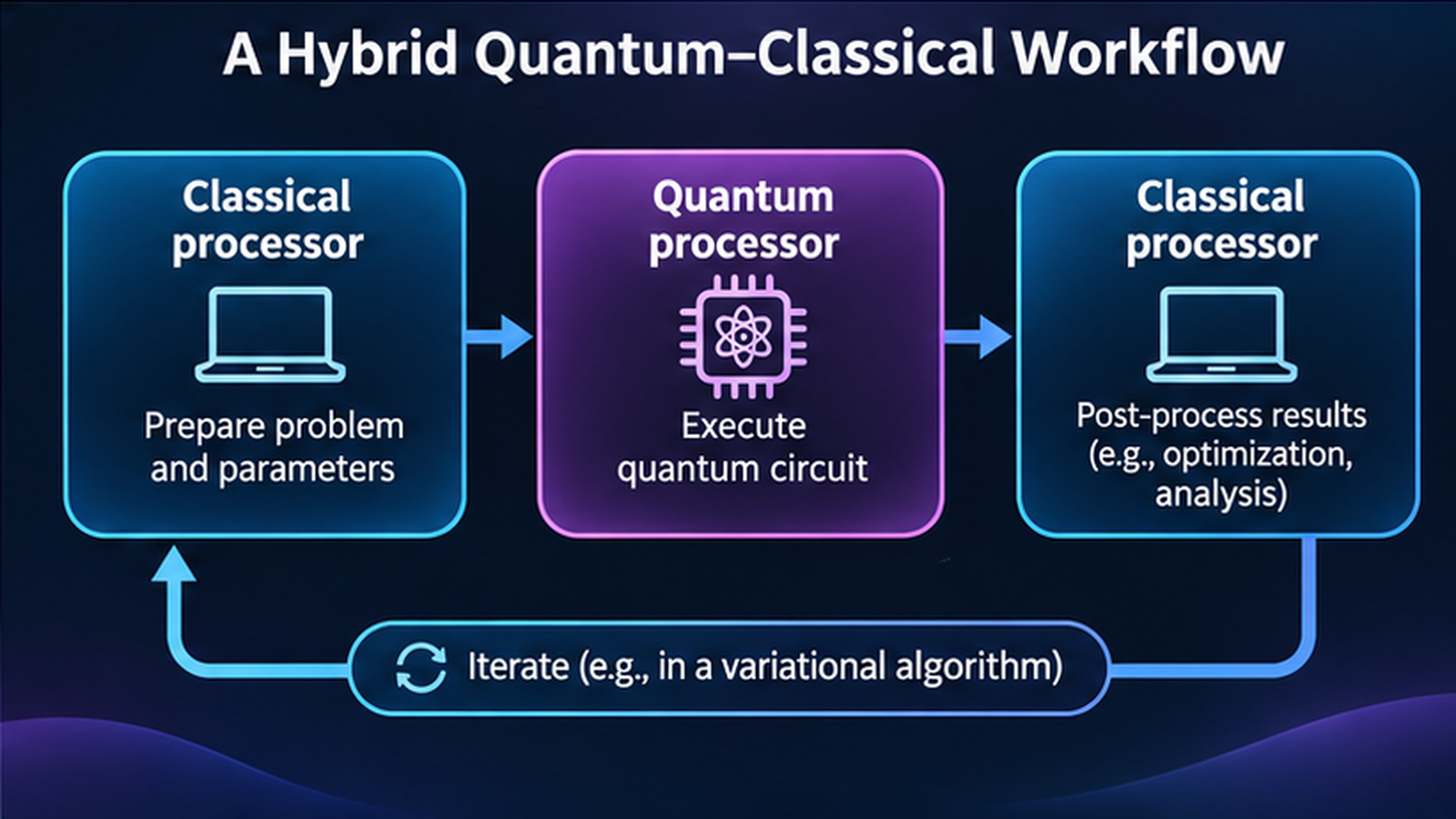
Variational quantum algorithms combine quantum circuits with classical optimization. A parameterized quantum circuit evaluates a state or objective function, while a classical optimizer repeatedly adjusts the parameters. Examples include:
These algorithms remain candidates for advantage because they can potentially use quantum hardware to represent or explore solution spaces that become expensive classically.
However, a general real-world advantage for optimization or machine learning has not yet been established. Current research is therefore focused on finding specific problem structures where the quantum component provides a measurable benefit.
Developers interested in this area can also explore BlueQubit's quantum machine learning and variational-classifier tutorials to see how these hybrid workflows are constructed.
Quantum simulation may be one of the most natural early applications of quantum computers because quantum hardware itself follows quantum mechanics. Instead of storing the exponentially large mathematical description of a quantum system on a classical computer, researchers can use qubits to represent aspects of that system directly.
Expectation-value estimation is particularly important because many problems in physics and chemistry do not require researchers to reconstruct an entire quantum state. They need specific observable quantities.
Reducing the problem to those quantities can make useful quantum computations possible much earlier than universal fault-tolerant computation.
Noise remains one of the main obstacles to practical quantum advantage. Two approaches are used to address it: quantum error mitigation and quantum error correction.
They solve related problems, but in fundamentally different ways.
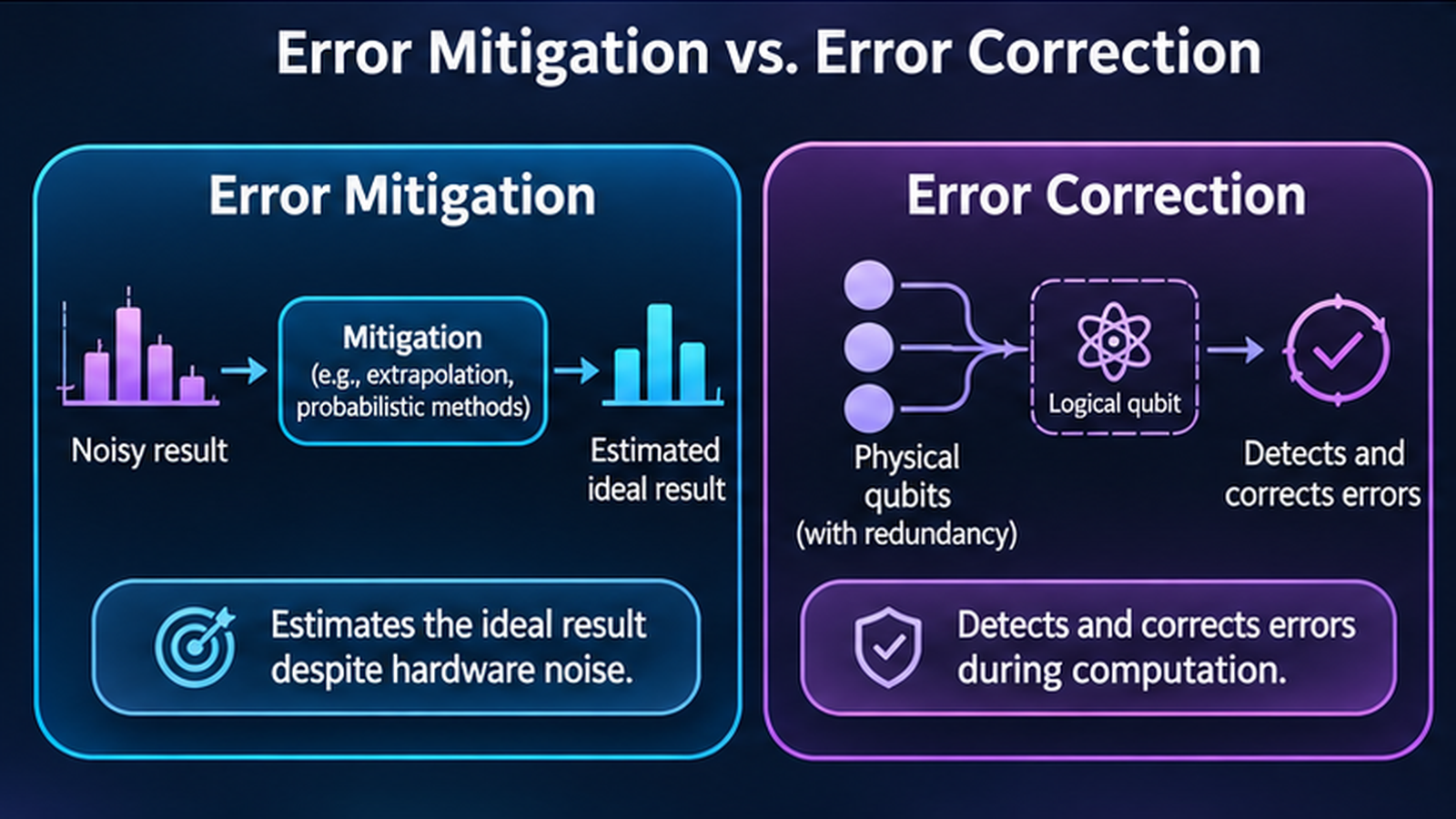
Error-mitigation techniques attempt to understand the effect of noise and mathematically reduce its influence on the final result. Examples include zero-noise extrapolation and probabilistic error cancellation, along with more specialized methods such as Qedma's QESEM.
These approaches are important because they work with today's noisy hardware without requiring thousands or millions of physical qubits for every useful logical computation. The 2026 Qedma result shows why mitigation remains important: meaningful quantum calculations can potentially reach beyond leading classical simulation before fully fault-tolerant machines exist.
Quantum error correction takes a more fundamental approach. Information from one logical qubit is encoded across multiple physical qubits. Errors can then be detected and corrected while preserving the logical quantum state. The cost is significant hardware overhead.
For that reason, large-scale fault-tolerant computation is still a future milestone rather than the standard architecture of today's quantum systems. IBM's current roadmap targets demonstrations of quantum advantage around its 2026 systems and its first large-scale fault-tolerant system, Starling, for 2029.
The two approaches are therefore complementary rather than competing. Error mitigation is helping researchers explore useful computation on today's hardware, while error correction is intended to make much deeper and more reliable quantum algorithms possible in the future.
BlueQubit's work focuses on both sides of the quantum advantage question: developing problems that could demonstrate an advantage and building classical tools that can challenge those claims.
One major research direction is peaked circuits. BlueQubit investigates whether such circuits can preserve a verifiable output while making the search for that output increasingly difficult for classical algorithms.
That combination addresses one of the central weaknesses of earlier quantum advantage demonstrations. BlueQubit's research has tested peaked circuits against multiple classical simulation strategies, including MPS, tensor-network approaches, and Pauli-path simulation.
As circuit size and depth increase, each classical method encounters different computational bottlenecks. Mapping those limits helps determine where a credible quantum advantage could begin.
BlueQubit also created the Quantum Advantage Challenge, which turns peaked-circuit research into an open computational challenge. Participants attempt to recover hidden bitstrings from a sequence of increasingly difficult peaked circuits.
The purpose is not simply to build a puzzle that is hard for classical computers. It is to expose the circuits to people who may discover better algorithms for solving them. That adversarial process is useful scientifically. A quantum advantage claim becomes stronger when researchers actively invite the classical community to break it.
BlueQubit also develops high-performance simulation tools used to test quantum utility and advantage claims. Its Pauli-path simulation work, for example, has shown that some large circuits that appear difficult for conventional state-vector simulation can still be tractable when researchers exploit their mathematical structure.
Tensor-network, GPU, MPS, and Pauli-path methods each perform differently depending on circuit depth, connectivity, noise, and entanglement. No single classical simulator represents the final benchmark.
For that reason, establishing an advantage requires testing quantum hardware against the strongest method suited to the particular circuit.

In July 2026, BlueQubit collaborated with Qedma, IBM, and RIKEN on a study of long-time Floquet Ising dynamics. Qedma used IBM quantum processors and its QESEM error-mitigation technology to estimate the system’s behavior.
RIKEN ran large-scale classical simulations on Fugaku, and BlueQubit ran GPU-based classical simulations. In the hardest regime, these classical approaches no longer produced consistent predictions. Independent error-mitigation techniques and additional checks on quantum hardware supported the quantum results.
The significance lies in the combination: rather than treating classical difficulty alone as proof, the collaboration tested the quantum result against intensive classical computation and independent validation methods.
The next stage is not simply building processors with more qubits. Researchers need to demonstrate advantage on a growing range of problems while making each result reproducible and verifiable.
Several milestones are now particularly important:
IBM's roadmap has targeted the end of 2026 for initial quantum advantage demonstrations and 2029 for its Starling fault-tolerant quantum computer. The July 2026 experiments suggest that the first milestone is beginning to arrive. The harder question now is how far that advantage can spread.
Quantum computing will not replace CPUs or GPUs for normal computing tasks. The likely future is a hybrid one in which quantum processors are used selectively for computational bottlenecks where their structure provides a measurable advantage. That makes the next few years less about proving that quantum computers can be different and more about identifying exactly where that difference is useful.
Yes, researchers have reported quantum advantage on specific, carefully defined computational tasks, including verifiable results in 2026. These findings do not establish a general advantage over classical computers, and each claim remains subject to improved classical methods.
Quantum supremacy refers to demonstrating that a quantum computer can perform a particular calculation beyond the practical reach of classical machines, even if the calculation itself has little practical value.
Quantum advantage is a stronger and more useful benchmark. It asks whether a quantum approach performs a task more efficiently, accurately, or cheaply than the best classical alternative and whether that result can be trusted.
Not generally. GPUs remain dramatically better suited to most current workloads, including machine learning, graphics, numerical computing, and simulating quantum circuits.
Quantum processing units, or QPUs, are specialized devices that may outperform CPUs or GPUs on certain problems with the right mathematical structure. In fact, GPUs remain essential to quantum computing research because researchers use them to simulate quantum circuits and test claims of quantum advantage.
The likely computing architecture is therefore not QPU versus GPU, but QPU with CPU and GPU resources.
For narrowly defined computational problems, advantage has already begun to appear. Broader useful quantum advantage will develop gradually rather than arriving on a single date. IBM has targeted 2026 for its first demonstrations of quantum advantage and 2029 for its Starling fault-tolerant system. Other hardware and software companies follow different roadmaps. The rate of progress will depend not only on better quantum processors but also on improvements in classical algorithms. Every faster classical simulation raises the threshold a quantum system must beat.
The strongest quantum advantage problems are, by definition, difficult for classical computers to calculate. That also makes their answers difficult to check. Researchers therefore need indirect validation methods such as error detection, statistical fidelity bounds, tests on smaller classically solvable instances, independent quantum hardware, or specially designed problems whose answers are difficult to find but easy to verify. This verification problem is why current research increasingly focuses not only on making quantum computations harder, but on making their results trustworthy.


