

Quantum circuits are how quantum algorithms are actually written. Where a classical program is a sequence of operations on bits, a quantum circuit is a sequence of operations on qubits, and because qubits can be in superposition and can become entangled, the operations available are richer and stranger than AND, OR, and NOT. This foundational technology is paving the way for breakthroughs in cryptography, optimization, artificial intelligence, and scientific simulations.
As research advances, platforms like BlueQubit are making quantum circuits more accessible, enabling scientists, engineers, and enthusiasts to explore their potential. So, what is a quantum circuit? How is it shaping the future of technology? With quantum circuit examples and more, this article covers all you need to know about this innovative element.
A quantum circuit is the quantum computing equivalent of a classical digital circuit. It's a fundamental concept in quantum technology, representing a universal set of quantum gates and qubits that perform specific computations. Types of quantum circuits include the quantum teleportation circuit and the quantum Fourier transform circuit.
Qubits are the fundamental units of quantum information. Unlike classical bits (0 or 1), they follow the law of superposition and exist in both 0 and 1 at the same time.
Quantum gates are similar to classical logic gates but operate on qubits using quantum principles. Examples include the Hadamard gate for superposition and the CNOT gate for entanglement.
Entanglement is a core feature of quantum circuits where qubits' states are interlinked, even across vast distances.
Concluding quantum circuits, measurement collapses qubits from superposition to classical states (0 or 1), providing the computation's result.
Quantum circuits show promise for specific computational problems like factoring large numbers, cryptography, optimization, and simulating quantum systems—tasks that are challenging for classical computers. However, current implementations remain limited by noise and qubit count.
In 2000, physicist David DiVincenzo set out the requirements (DiVincenzo's Criteria) any physical system must meet to serve as a practical quantum computer. They remain the standard checklist for evaluating hardware platforms. There are five core criteria:
You need a way to make many qubits whose properties you understand precisely. Superconducting circuits, trapped ions, neutral atoms, photons, and silicon spin qubits are the leading candidates.
The ability to initialize qubits to a simple fiducial state. Computation must start from a known state, typically |000...0⟩. Accurate initialization of qubits into a known state and precise measurement outcomes are essential for reliable quantum computing.
A finite set of gates from which any quantum operation can be built, to arbitrary accuracy.
Quantum states degrade through interaction with their environment. The ratio between how long a qubit survives and how long a gate takes determines how deep a circuit you can run.
Quantum states degrade through interaction with their environment. The ratio between how long a qubit survives and how long a gate takes determines how deep a circuit you can run.
DiVincenzo added two further criteria for quantum communication and networked systems:
Diagrams of quantum circuits provide a visual representation of quantum computing circuits and a simple framework for understanding and executing quantum computations. These quantum circuit diagram examples use symbols and lines to represent quantum information flow over a circuit, just like their classical counterparts.
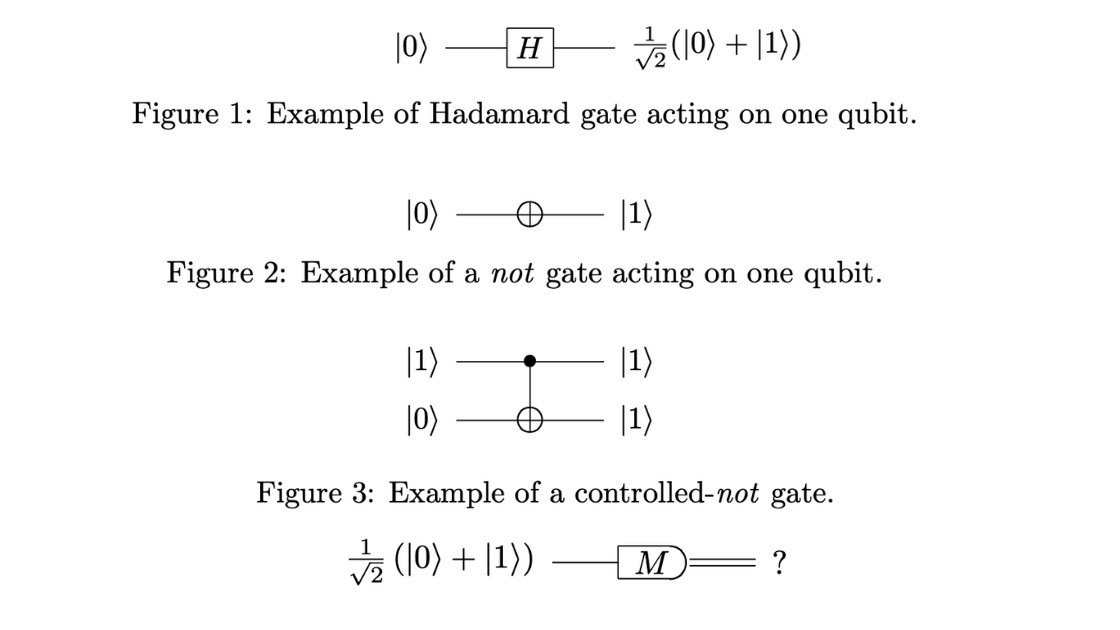
Qubit lines: Horizontal lines are frequently found in quantum circuits, each representing a qubit. These lines trace the evolution of the quantum bits as they move through the circuit.
Quantum gates: Symbols for quantum gates are used on the quantum circuit. The Hadamard gate, for instance, is indicated by an "H," whereas the CNOT gate is depicted as a cross with a control and target qubit.

Gate operations: Gates to qubit lines indicate the application of quantum gates on specific qubits. Position along the wire is the time ordering. Operations on the left happen first. The initial state, usually |0⟩, is labelled at the left end of each wire.
Superposition and entanglement: Quantum circuit diagrams depict operations like superposition and entanglement. Superposition is visually represented from the effect if a gate such as H, while entanglement is shown from a two qubit gate between separate qubit wires.
Measurements: Quantum measurements, which collapse qubits' states into classical outcomes, are represented by a meter symbol placed at the end of a wire. Its output feeds a double line, which represents a classical bit rather than a qubit. Double lines are how you tell classical wires from quantum ones.
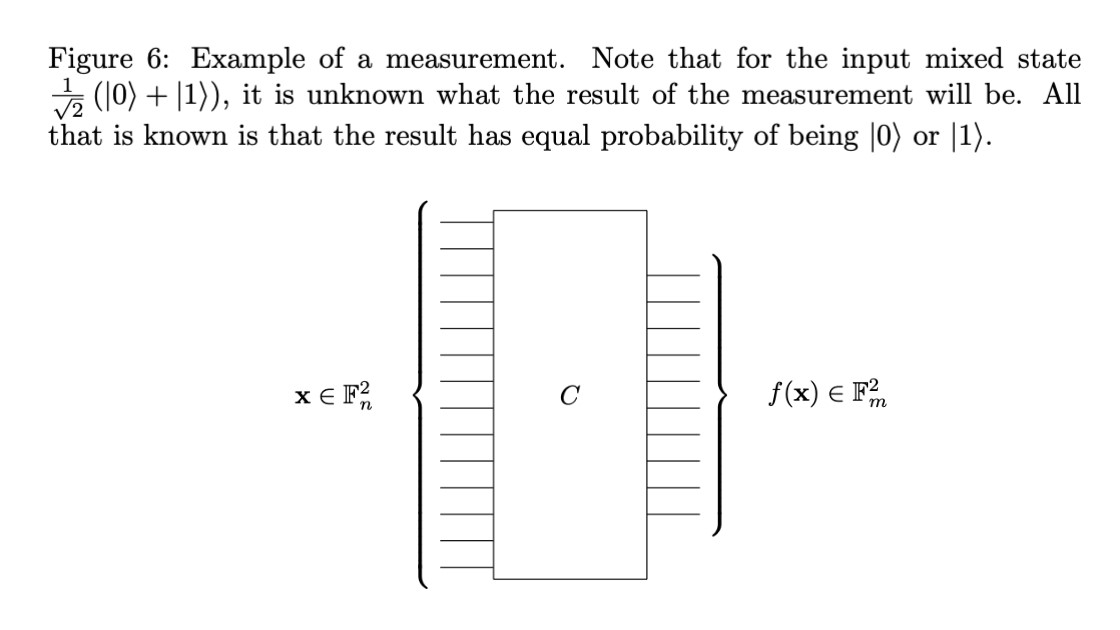
Quantum circuit design diagrams are valuable tools for quantum algorithm design and research communication. They simplify complex quantum computations, allowing researchers and enthusiasts to visualize and analyze quantum circuits. This leads to advancements in quantum computing.
The two fundamentally different paradigms of computation are represented by quantum circuits and classical circuits, each with its own distinctive features and capabilities.
Classical computers are efficient for everyday tasks but struggle with complex problems like prime factorization and simulating quantum systems.
Quantum computers excel in solving specific problems exponentially faster than their classical counterparts.
Quantum gates manipulate qubits in different ways, and each gate performs a specific operation that forms part of a larger quantum algorithm. By combining multiple gates, a quantum circuit can create superposition, generate entanglement, or transform quantum states to solve computational problems that would be difficult for classical computers.
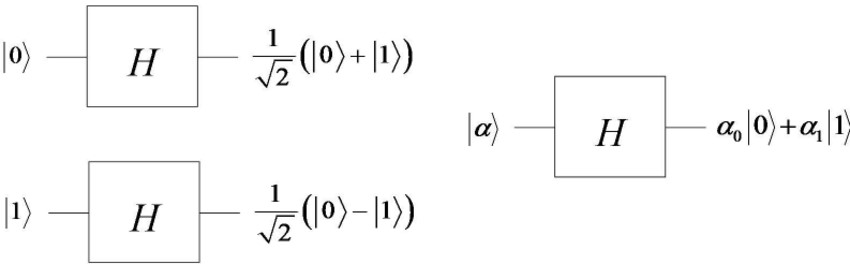
The Hadamard gate is a crucial quantum gate. It puts a qubit into a superposition of states.
For example, if a qubit starts in the |0⟩ state, applying a Hadamard gate places it into a superposition where it has an equal probability of being measured as 0 or 1. Instead of holding a single value, the qubit can now participate in many computational paths at once.
This ability to prepare qubits for parallel computation is a key reason quantum algorithms can outperform classical ones for certain problems. The Hadamard gate is used extensively in algorithms such as Grover's search algorithm, Shor's factoring algorithm, and the Quantum Fourier Transform.
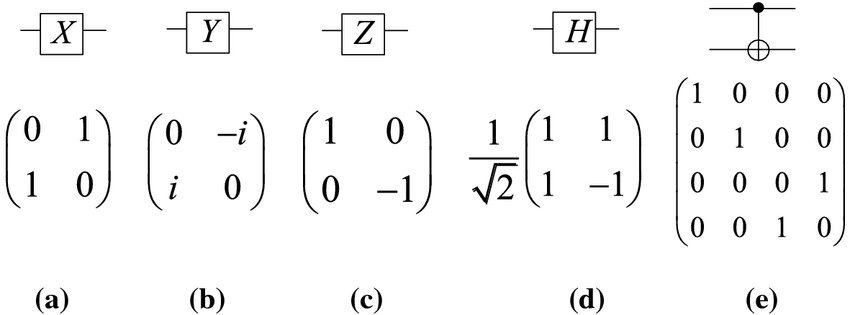
Also known as the quantum NOT gate, Pauli-X flips the state of a qubit. Applying X to |0⟩ results in |1⟩, and vice versa. Unlike a classical NOT operation, however, it also works on qubits that are already in superposition, transforming every component of the quantum state. This makes it a fundamental building block for preparing quantum states and implementing more complex quantum operations. The Pauli-X gate frequently appears in quantum algorithms, error correction protocols, and state initialization circuits.

The Pauli-Y and Pauli-Z gates perform operations that change a qubit's phase rather than simply flipping its value. The Y gate combines a bit flip with a phase shift, while the Z gate leaves the probability of measuring the qubit unchanged but reverses the phase of the |1⟩ component.
Although phase changes cannot be observed directly through a single measurement, they influence how quantum states interfere with one another later in the computation. Because quantum algorithms often rely on constructive and destructive interference, phase gates are essential for controlling computational outcomes.
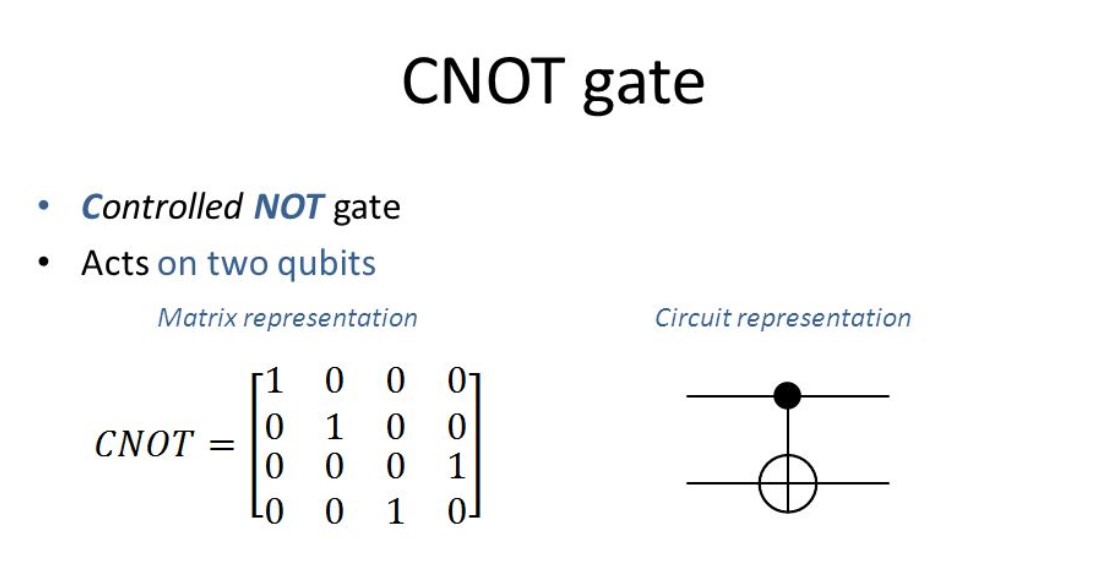
The Controlled-NOT gate acts on two qubits: a control qubit (C) and a target qubit (T). Imagine two qubits, A and B. If qubit A is the control and is measured as |1⟩, the CNOT gate flips qubit B. If A is |0⟩, nothing happens. This gate is crucial for creating entanglement, a key resource in quantum computing. Combined with a Hadamard gate, the CNOT gate can generate entangled qubits, which share correlations that cannot be explained by classical physics.
The S and T gates are phase gates that rotate a qubit's phase by fixed amounts without changing its measurement probabilities. While their individual effects are subtle, they become extremely powerful when combined with other quantum gates to build more sophisticated circuits. In particular, the T gate is one of the fundamental gates required for universal quantum computation and plays a central role in fault-tolerant quantum computing. Modern quantum compilers and error-corrected quantum architectures often measure circuit complexity by the number of T gates required, making them especially important for practical quantum algorithms.
Quantum circuits become essential instruments in the quest for computing capacity beyond the constraints of classical theory. The potential of quantum computing is centered on these circuits, which give way to innovations in various fields.
Quantum circuits are bound to revolutionize cryptography, addressing a pressing concern in the digital age: the potential threat posed by quantum computers to traditional encryption methods. Quantum computing, harnessed through quantum circuits, offers innovative solutions in two crucial areas of cryptography.
The emergence of quantum computers threatens the security of classical encryption algorithms. Quantum circuits are crucial in the development and implementation of quantum-resistant cryptographic techniques, guaranteeing that data remains confidential and secure.
Quantum circuits play a major role in the implementation of QKD protocols, such as BB84. These protocols use quantum mechanics to establish a shared secret key, secured by physics rather than computational hardness. Any attempt to intercept quantum-entangled particles disrupts communication, providing a secure channel for exchanging sensitive information. Imagine sending a sealed envelope that automatically tears if anyone opens it. Quantum key distribution works in a similar way. Measuring the quantum states changes them, and makes eavesdropping immediately detectable.
Recommended Reading
Unraveling the Secrets of Quantum Cryptography: What Is It and How to Prepare?
Along with encryption, machine learning is also undergoing a revolution because of quantum circuits.
Quantum circuits excel in processing and analyzing vast datasets exponentially faster than their classical counterparts. This speedup can significantly improve machine learning tasks such as data classification and optimization.
A quantum computer circuit is the backbone of quantum machine learning algorithms. It makes use of quantum properties like superposition and entanglement to solve complex problems, from quantum chemistry simulations to optimization tasks, with remarkable efficiency.
In terms of quantum neural networks, quantum circuits promise advancements in deep learning. They offer a unique approach to training and processing neural networks, potentially unlocking new capabilities in artificial intelligence.

With tools like a quantum circuit simulator, BlueQubit plays a key role in the progress of quantum computing and its integration into advanced learning methodologies. It offers researchers and professionals the resources to fully exploit the possibilities of quantum-assisted machine learning. You get access to the infrastructure and resources you need to explore this frontier if you're looking to use quantum circuits for machine learning applications—among others.
Researchers and developers can build their own quantum computing circuits in Qiskit. Here’s an example of a Qiskit quantum circuit that demonstrates entanglement:

In the face of advancing quantum computing and its potential to reshape technology, quantum circuits emerge as essential building blocks. They unlock the door to solving complex problems beyond the capabilities of classical computers. This innovative technology can effectively process large datasets at unprecedented speeds, unlocking new horizons in fields like cryptography and machine learning.
Quantum circuits use qubits instead of classical bits, allowing them to exist in superposition and take advantage of entanglement to perform computations much faster. Unlike classical circuits, which rely on Boolean logic gates (AND, OR, NOT), quantum circuits use quantum gates like Hadamard, CNOT, and Pauli-X to manipulate qubits. These unique properties allow quantum computers to solve complex problems that are not possible for traditional computers.
A quantum circuit consists of qubits, which store quantum information, and quantum gates, which perform operations on these qubits. Key gates include the Hadamard gate (for superposition), the CNOT gate (for entanglement), and the Pauli gates (for state transformations). Quantum circuits also include measurement operations, where qubits collapse from their quantum states into classical values (0 or 1), providing the final output of a computation.
Quantum measurements are inherently probabilistic. Each time we run a quantum circuit and measure its qubits, we get one possible outcome according to the probability distribution defined by the quantum state. To characterize this distribution accurately, we need to run the same circuit multiple times and collect statistics on the measurement outcomes. This statistical approach is fundamental to extracting meaningful results from quantum algorithms.
The Integrated Quantum Optical Circuit (IQOC) Market refers to the industry that focuses on the development, production, and commercialization of integrated photonic circuits designed for quantum computing, quantum communication, and quantum sensing. These circuits use light (photons) instead of electrons to carry out quantum operations, making them a key component in scalable and energy-efficient quantum technologies.


