

Ever wondered how reality would look if you could be in two places at the same time? Welcome to quantum computing, where the superposition principle turns this sci-fi concept into a scientific possibility.
This comprehensive guide focuses on understanding quantum superposition, the cornerstone of quantum computing. You’ll get familiar with the superposition principle, quantum states, and its influence on Schrödinger's famous feline paradox.

So, what is quantum superposition? Superposition in quantum computing is the principle that allows a quantum particle, such as an electron or photon, to exist in a combination of multiple possible states at the same time. Unlike a classical object, which must be in one definite state, a quantum system can be described by several states simultaneously until it is measured.
A simple way to think about it is with a flipped coin. A classical coin is either heads or tails once it lands. A quantum "coin," however, can exist in a combination of both possibilities until a measurement is made. When that measurement occurs, the superposition ends and the particle is found in one definite state.
Mathematically, we see this behavior because quantum states can be added together to form another valid quantum state. This principle forms the foundation of many quantum phenomena, including interference, entanglement, and the computational power of quantum computers.
Beyond quantum computers, superposition is a fundamental property of nature. At the atomic and subatomic level, particles such as electrons can exist in a combination of multiple quantum states, influencing how atoms, molecules, and materials behave. This principle helps explain phenomena such as atomic energy levels, chemical bonding, and the electronic properties of solids.
In chemistry, superposition allows electrons to occupy quantum states that determine how atoms interact to form molecules. Rather than simply switching between fixed states, quantum systems are described by a combination of possible states until a measurement or interaction occurs. These quantum behaviors underpin many of the physical and chemical processes observed at microscopic scales.
Researchers are also investigating whether quantum coherence—a phenomenon closely related to superposition—contributes to processes such as photosynthesis and certain biological reactions. While evidence suggests quantum effects can occur in some biological systems, the extent to which they influence biological function remains an active area of research.
To better understand quantum superposition, physicist Erwin Schrödinger proposed a famous thought experiment in 1935 known as Schrödinger's Cat. Rather than describing a real experiment, it was designed to illustrate the strange consequences of applying quantum mechanics to everyday objects.
Imagine a cat sealed inside a box with a radioactive atom, a Geiger counter, a vial of poison, and a hammer. If the radioactive atom decays, the Geiger counter detects it, causing the hammer to break the vial and release the poison. If the atom does not decay, the cat survives. According to quantum mechanics, the radioactive atom is described by a superposition of decayed and undecayed states until it is measured. Because the cat's fate depends entirely on the atom, the thought experiment suggests that the entire system is also described by a superposition, leading to the famous paradox of the cat being considered both alive and dead until observation.
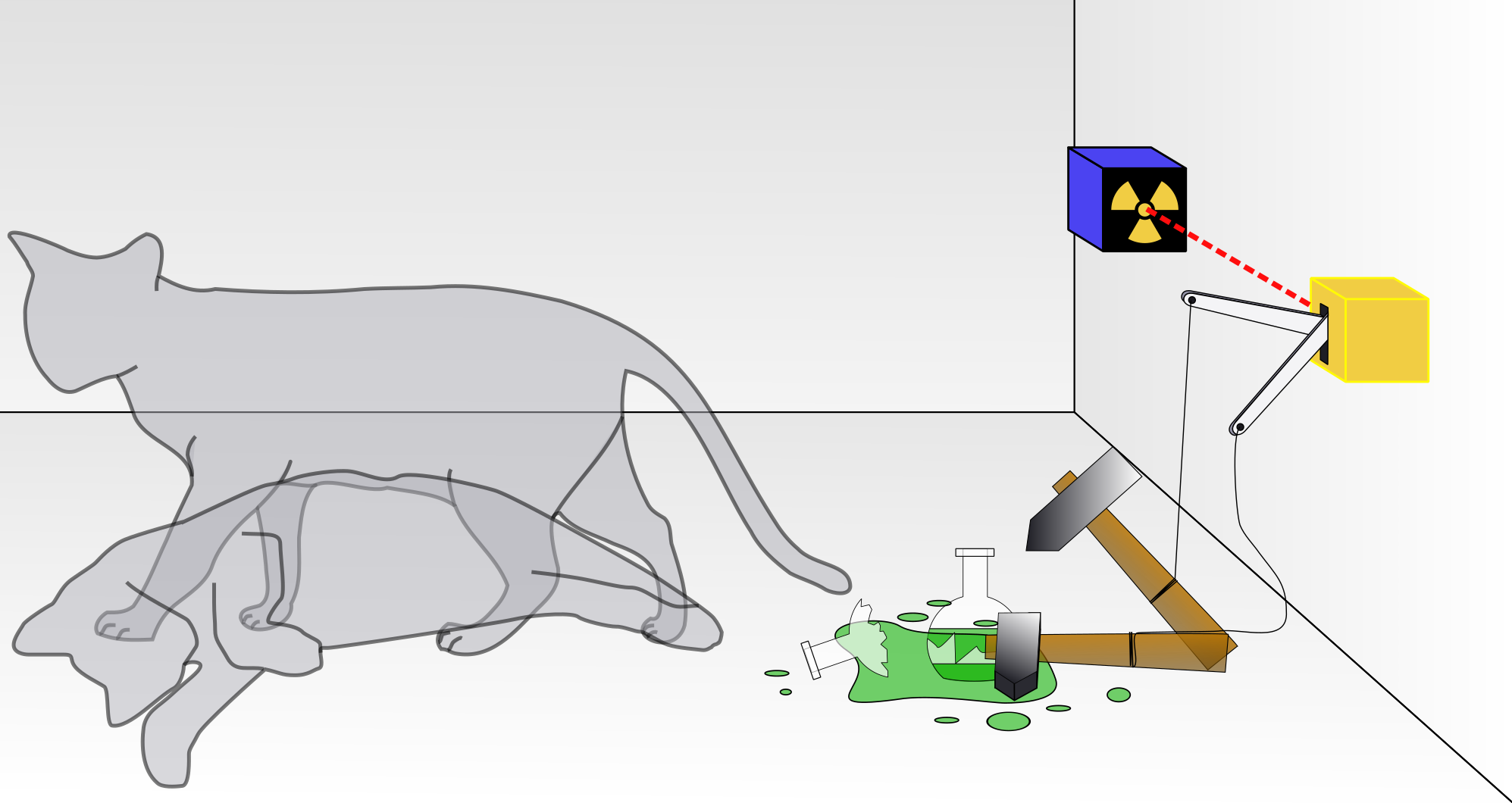
Although bizarre, this example illustrates how quantum systems are described before measurement. Particles such as electrons can exist in a superposition of multiple possible states, rather than occupying one definite state. When a measurement is made, the superposition collapses into a single outcome. Quantum computers exploit this property by placing qubits into superposition, allowing them to represent combinations of 0 and 1 that classical bits cannot.
It's important to remember that Schrödinger's Cat was never intended to prove that a cat could literally be both alive and dead. Instead, Schrödinger introduced the thought experiment as a critique of the Copenhagen interpretation of quantum mechanics, questioning whether the rules governing microscopic particles should be applied directly to macroscopic objects.
The superposition principle is the principle that intertwines with Schrödinger's Equation to shape the reality of subatomic particles. So, how do these quantum computing basics interplay?
The Schrödinger equation describes how the quantum state of a system evolves over time. One of its most important mathematical properties is linearity, which makes the superposition principle possible. Because of this property, quantum systems can be described by combinations of multiple valid quantum states rather than being limited to a single state before measurement.

But what does "linearity" actually mean? Simply put, if ψ₁ and ψ₂ are valid solutions to Schrödinger's equation, then any combination aψ₁ + bψ₂ is also a valid solution, where a and b are complex numbers. This mathematical property allows quantum states to combine into superpositions, forming the foundation of many quantum phenomena and the operation of quantum computers.
When Schrödinger's equation is solved for a quantum system, it produces a set of solutions known as eigenstates, each representing a possible state of the system, such as a specific energy level of an atom. The superposition principle states that a particle does not have to occupy just one of these eigenstates. Instead, its quantum state can be described as a combination of multiple eigenstates until a measurement is made.
Another important aspect of quantum mechanics is its relationship with probability theory. At first glance, these two fields may seem unrelated, but probability is fundamental to describing how quantum systems behave and predicting the outcomes of measurements.
The connection between probability theory and the quantum mechanical model of the atom stems from the fundamental postulate of quantum mechanics. This postulate states that a particle is described by a wave function, and the probability of observing a particular outcome is found by squaring the magnitude of that wave function, a principle known as the Born rule. Rather than assigning ordinary probabilities to a particle's state, quantum mechanics uses probability amplitudes, which determine the likelihood of different measurement outcomes.
A simple way to understand the difference is to imagine a roulette wheel. In classical probability, the ball will land on one number even if you do not know which one in advance. The uncertainty comes from incomplete knowledge of the system. In quantum mechanics, however, a particle is described by a superposition of possible states before measurement. When a measurement is made, the wave function collapses into one definite state, with the probability of each outcome determined by its probability amplitude.
This framework is often referred to as quantum probability theory. Unlike its classical counterpart, which works directly with probabilities, this theory describes quantum systems using complex-valued probability amplitudes. These amplitudes can interfere with one another, allowing some outcomes to become more likely while others are suppressed. This unique behavior underpins quantum phenomena such as superposition and interference, and ultimately enables quantum computers to perform certain computations more efficiently than classical machines.

One of the clearest demonstrations of quantum superposition is the double-slit experiment. In the classical version of the experiment, particles passing through two separate slits should create two distinct bands on a screen behind them. But when quantum particles such as electrons or photons are used, the result is very different: instead of two simple bands, the particles create an interference pattern similar to waves overlapping with each other.
This happens because quantum particles exist in a superposition of states while traveling through the experiment. Rather than moving through only one slit at a time, the particle behaves as though it passes through both slits simultaneously until a measurement is made. The interference pattern emerges because the probability amplitudes associated with each possible path combine together, reinforcing some outcomes and canceling others.
The experiment changes completely once observation is introduced. If detectors are placed near the slits to measure which path the particle takes, the interference pattern disappears and the particles behave more like classical objects. This transition is one of the foundational examples of how measurement affects quantum systems.
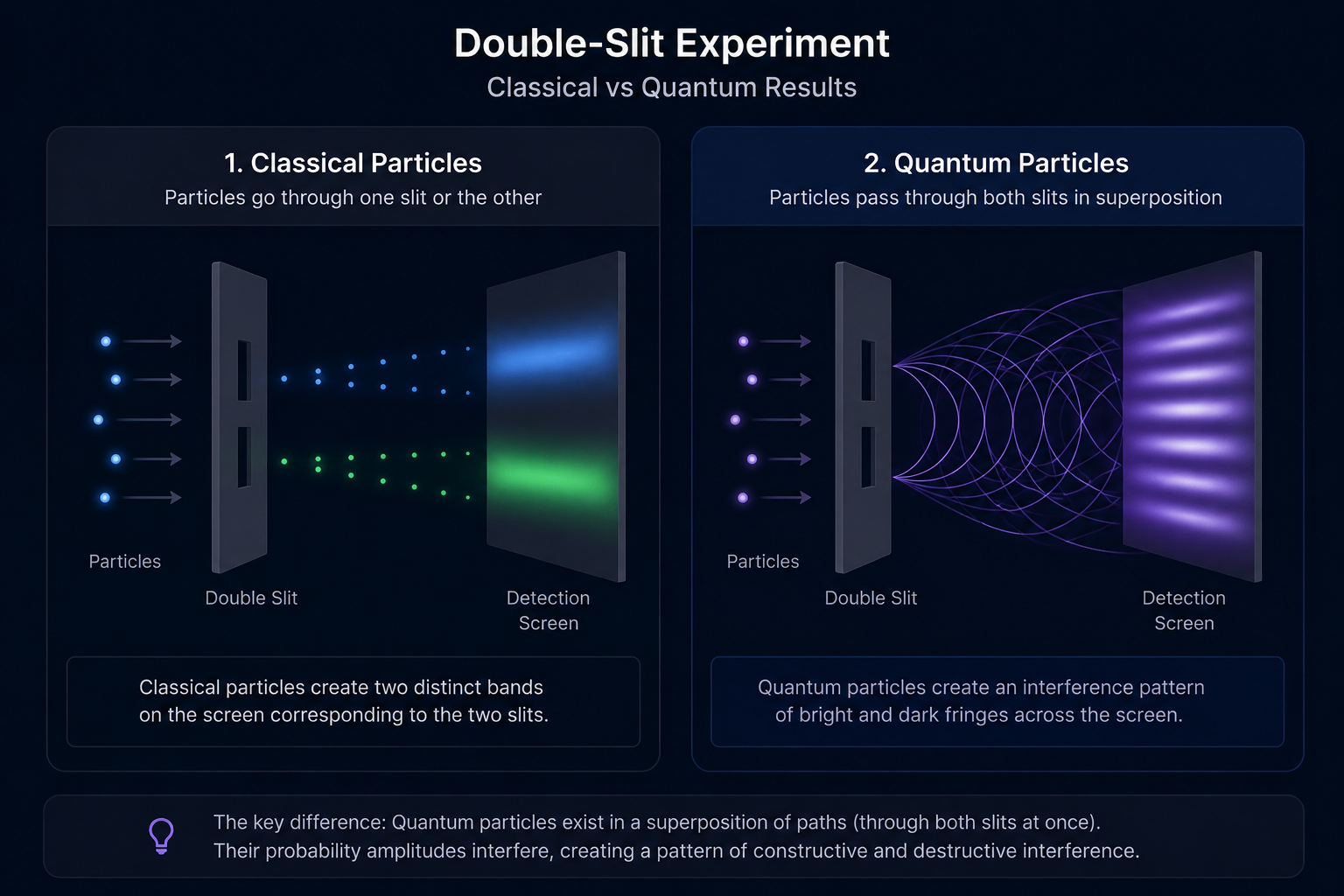
Quantum interference is what allows superposition to become computationally useful. When a quantum system exists in multiple states at once, each possible state carries a probability amplitude that can interact with the amplitudes of other states. These interactions create constructive interference, where certain outcomes become more likely, and destructive interference, where incorrect or unwanted outcomes are suppressed.
This is the mechanism behind most quantum algorithms. Rather than simply “trying every possibility at once,” quantum computers manipulate interference patterns so that the probabilities of correct answers are amplified while incorrect answers cancel out. Algorithms such as Grover’s Search rely heavily on carefully engineered interference effects to achieve computational advantages over classical approaches.
Superposition and entanglement are closely connected concepts in quantum computing. Superposition in quantum computing allows individual qubits to exist in multiple possible states at the same time, while entanglement links multiple qubits together so that the state of one qubit becomes dependent on the state of another.
When combined, these two properties allow quantum systems to represent and process highly complex probability spaces that would be difficult for classical systems to model efficiently. Superposition creates the range of possible computational states, while entanglement coordinates relationships between qubits, enabling quantum algorithms to manipulate many interconnected possibilities simultaneously.
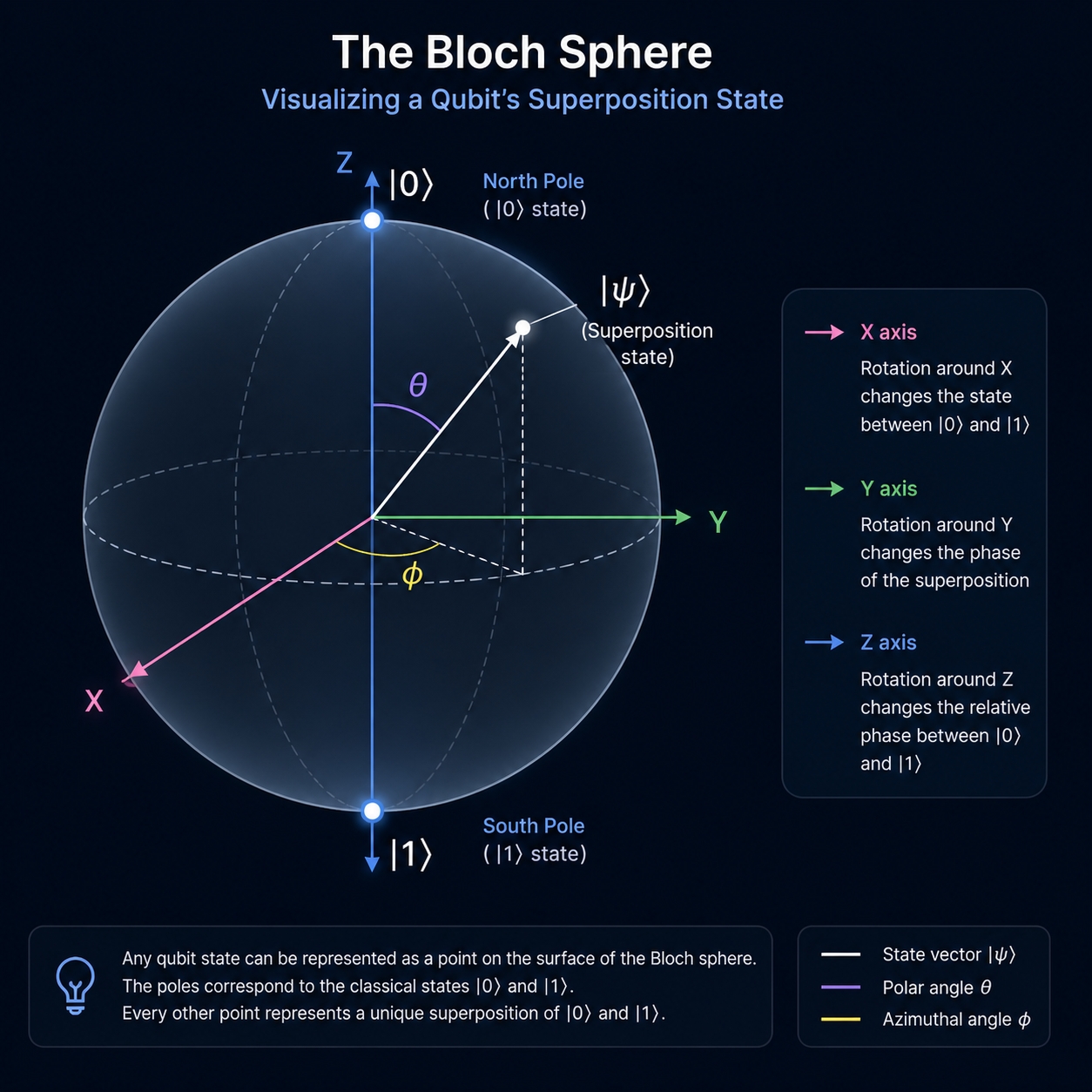
One of the most common ways to visualize a qubit’s superposition state is through the Bloch sphere, a geometric representation of quantum states shown as points on the surface of a sphere. In classical computing, a bit can only exist as either 0 or 1, but a qubit can occupy a superposition between those two states. The Bloch sphere helps illustrate this by showing how a qubit can “point” in many possible directions rather than remaining fixed in a single binary state.
In simple terms, the north and south poles of the sphere represent the classical states |0⟩ and |1⟩, while every other point on the sphere's surface represents a different superposition of the two. Quantum gates manipulate the qubit by rotating its state around the sphere, which is one of the reasons geometric visualization is so useful in quantum computing and quantum algorithm design.
One of the biggest differences between classical and quantum computing is how information scales. A classical computer with three bits can represent eight possible values, but only one at a time. A quantum computer with three qubits can exist in a superposition of all eight basis states until measurement.
As more qubits are added, the number of possible quantum states grows exponentially. A system with 10 qubits can represent up to 1,024 basis states, while 50 qubits can represent more than one quadrillion. This enormous state space is what gives quantum computers the potential to tackle certain optimization, simulation, and machine learning problems more efficiently than classical computers.
However, simply having access to many possible states is not enough. Quantum algorithms must use superposition, interference, entanglement, and measurement to amplify the correct answers while suppressing incorrect ones.
In quantum computing, qubits are placed into superposition through quantum gate operations that manipulate their probability amplitudes. One of the most common gates used for this purpose is the Hadamard gate, often written as H.
When applied to a qubit in the classical |0⟩ state, the Hadamard gate transforms it into an equal superposition of |0⟩ and |1⟩. Instead of representing a single binary value, the qubit now carries a probability distribution across both states simultaneously. Quantum algorithms frequently begin by applying Hadamard gates to multiple qubits at once, creating large superposition spaces that can later be manipulated through interference and entanglement.
What if the thrill of quantum exploration wasn't confined to sophisticated laboratories but accessible from the comfort of your home or office? Enter BlueQubit, a platform designed to democratize quantum computing, allowing you to experiment with the principle of superposition and more without the need for expensive quantum computing hardware and software solutions.
BlueQubit makes quantum computing accessible to businesses. Our platform's intuitive interface removes barriers to quantum experimentation, allowing you to harness quantum advantages without specialized hardware or expertise. With our cloud-based quantum computing software platform, you get access to advanced quantum simulators and real quantum hardware from your own device. Our integration with tools like Cirq and Qiskit means your team can start building quantum solutions immediately, positioning your business at the forefront of this emerging technology.

Beyond mere exploration, BlueQubit's tools support research and development across areas such as chemistry, optimization, machine learning, and quantum algorithm design, helping teams prototype and test quantum workflows before deploying them on real hardware.
With industry-leading quantum computing simulators, BlueQubit allows students, professionals, curious enthusiasts, and budding quantum physicists to experiment with quantum technology computing and experience the superposition principle in action.
A primary advantage of superposition in quantum computing is superposition. Unlike classical bits, which can be either 0 or 1, qubits can exist in both states at the same time. This allows quantum computers to solve complex problems, such as optimization and cryptography, much faster than traditional computers. Superposition also improves machine learning, simulations, and data analysis by exploring multiple solutions at once.
Quantum superposition emerged from the collective development of quantum mechanics in the 1920s, with foundational contributions from Heisenberg, Schrödinger, Dirac, and Bohr. The concept comes from Schrödinger’s Equation, which describes how quantum systems evolve and how particles can exist in multiple states simultaneously. Despite this, Paul Dirac is most credited with formally stating the superposition principle.
Quantum superposition has been confirmed through multiple experiments, such as the double-slit experiment and quantum interference tests. In the double-slit experiment, particles like electrons or photons act as waves and pass through both slits at the same time, forming an interference pattern. Bell tests further show that measurement outcomes cannot be explained by pre-existing local properties
Superposition is a key aspect of quantum computing because it allows qubits to operate on exponentially superimposed states at once. This capability makes parallel processing possible on an unprecedented scale, reducing the time it takes to solve complex problems. Applications such as drug discovery, cryptography, artificial intelligence, and materials science benefit from quantum superposition, which allows for simulations and optimizations that are otherwise impossible.
Quantum computers use superposition by encoding information in qubits, which can exist as both 0 and 1 simultaneously rather than being limited to one state at a time. With the help of quantum gates and entanglement, quantum algorithms manipulate these superposed states use interference patterns to boost ideal states from an exponentially sized state space. This allows for breakthroughs in fields like cryptography, search algorithms, and machine learning.
Superposition describes how a single qubit can exist in multiple possible states at the same time until it is measured. Entanglement, by contrast, describes a relationship between multiple qubits where their states become correlated, meaning the state of one qubit depends on the state of another even when separated by large distances.
The double-slit experiment is one of the foundational experiments in quantum mechanics. It demonstrates that quantum particles such as electrons and photons can behave like waves and exist in superposition, producing interference patterns that disappear once the particles are directly measured or observed.
Superposition cannot be observed directly in the same way classical objects can be seen or measured. Instead, scientists infer the existence of superposition through experimental results such as interference patterns, probability distributions, and quantum measurement outcomes that cannot be explained by classical physics alone.


