

Quantum machine learning (QML) applies quantum mechanical principles — superposition, entanglement, and interference — to machine learning tasks, typically by running parameterized quantum circuits inside a hybrid loop with classical optimizers. It targets a specific set of problems where quantum processors may represent or search data more efficiently than classical hardware: high-dimensional feature spaces, combinatorial optimization, and data that originates from quantum systems.
Note that QML is a research field, not a deployed technology. No quantum machine learning model currently outperforms classical methods on a real-world task. What follows covers how it works, the five algorithms that matter, where it plausibly helps, and the constraints that keep it in the lab.
Quantum machine learning (QML) is an emerging field that applies principles of quantum mechanics to enhance the processing of large datasets and tackle computations that are difficult for classical computers. QML draws on the same physics that describes atoms and subatomic particles. For background, see our guide to the quantum mechanical model of the atom.
In QML, quantum algorithms are combined with machine learning models to improve tasks such as classification, clustering, and optimization. Quantum-enhanced machine learning techniques, such as quantum support vector machines (QSVMs) and quantum neural networks (QNNs), process high-dimensional data more efficiently than classical methods. Research activity concentrates in healthcare, finance, and logistics, where problem structures fit and data volumes justify the effort.
For example, QML can accelerate drug discovery by simulating molecular interactions at a granular level or optimize financial portfolios by analyzing massive datasets for patterns and predictions. That being said, QML faces challenges like hardware limitations, error correction, and the need for specialized quantum algorithms.
<div>{{quantum-learning-banner}}</div>
Quantum machine learning works by encoding data into quantum states, processing it with parameterized quantum circuits, and extracting results via measurement. Often within a hybrid quantum-classical loop. The typical workflow looks like this:
This hybrid approach—quantum circuits for representation and classical optimizers for training—is the backbone of most practical QML methods today, including variational quantum classifiers, quantum neural networks, and variational eigensolvers. This hybrid structure is not a stopgap. Classical optimizers are good at parameter search and quantum circuits are not, so the division of labour is likely to persist even on fault-tolerant hardware.
QSVM is a quantum version of the classical support vector machine that uses quantum subroutines to compute kernel matrices or solve linear systems more efficiently. It is used when the dataset benefits from quantum-enhanced kernel evaluation, particularly in high-dimensional feature spaces where classical kernel methods become costly. QSVM can offer speedups in specific settings but depends heavily on efficient data loading and low-noise hardware.
A QNN replaces or augments classical neural network layers with parameterized quantum circuits that act as trainable feature transformers. It is used for classification, regression, and representation learning tasks where quantum circuits can capture complex, non-linear relationships in data. QNNs are typically trained via hybrid loops and are most practical on near-term devices with limited qubit counts.
A variational quantum classifier is a variational algorithm that uses a parameterized quantum circuit to classify data by optimizing a cost function based on measurement outcomes. It is used for supervised learning tasks such as binary or multi-class classification, especially when the problem structure aligns with the circuit's expressivity. VQCs are among the most common QML models tested on current quantum hardware.
VQE is a hybrid algorithm that finds the lowest eigenvalue (ground state energy) of a Hamiltonian by minimizing the expectation value over a parameterized quantum state. While originally designed for quantum chemistry, VQE is used in QML for optimization and training objectives that can be cast as eigenvalue problems. It is a foundational building block for many variational quantum algorithms.
QAOA is a variational algorithm tailored for combinatorial optimization problems, approximating solutions by alternating between problem-specific and mixing Hamiltonians. It is used for tasks like Max-Cut, portfolio optimization, and routing problems where the objective can be encoded into a cost Hamiltonian. QAOA has long been treated as a leading candidate for near-term quantum advantage, though recent results complicate that. In a July 2026 study on Quantinuum's 98-qubit Helios system, standalone QAOA failed to find optimal solutions for portfolio problems built from S&P 100 and Nikkei 225 data — while a hybrid method that used QAOA's measurements to guide classical reductions succeeded, reaching success probabilities of 0.40 and 0.95. The emerging lesson is that QAOA may be more useful as a subroutine informing classical solvers than as a standalone optimizer.
Quantum machine learning is not a wholesale replacement for classical ML; it offers advantages in specific problem classes while remaining constrained by hardware and data-loading bottlenecks.
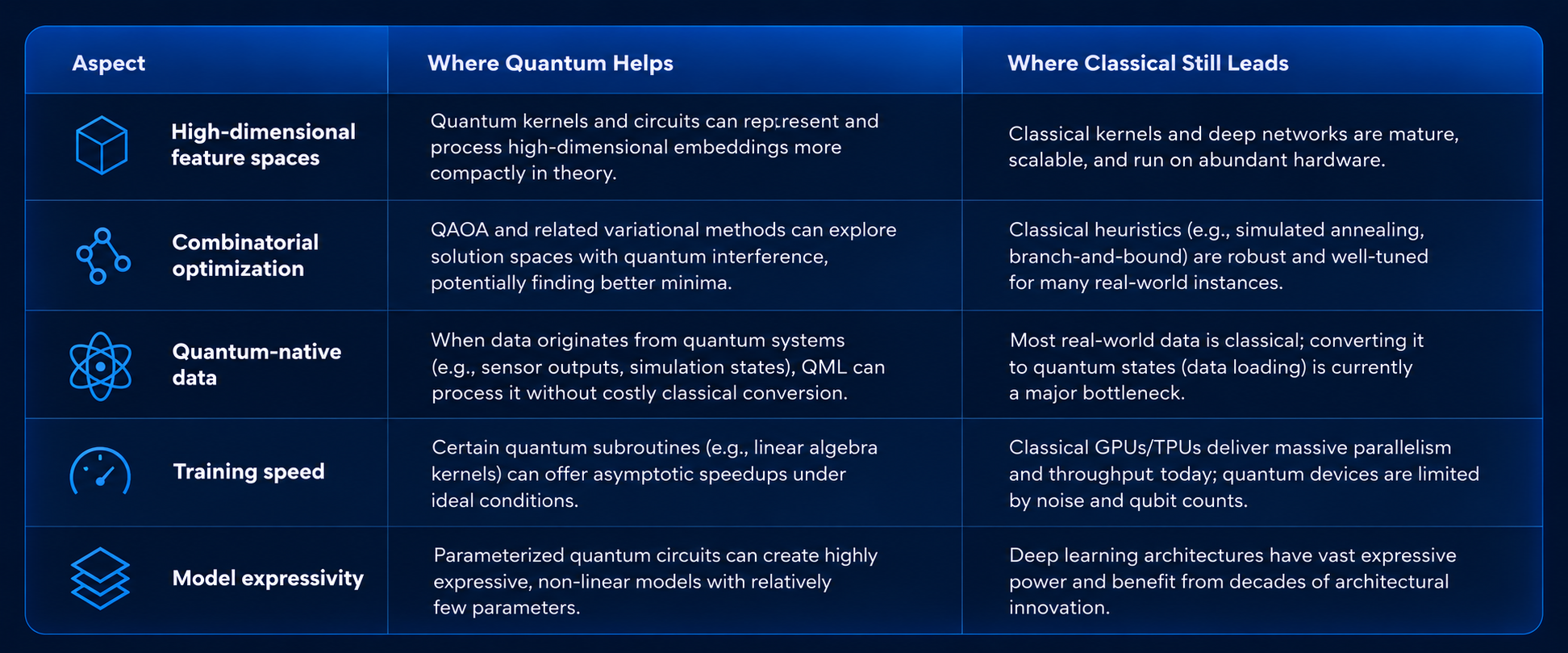
In practice, hybrid workflows—using quantum subroutines for specific bottlenecks within classical pipelines—are the most realistic near-term path.
Despite its promise, QML faces significant practical constraints that limit its deployment today.
These limitations mean QML is currently best viewed as a research-oriented tool and a potential accelerator for specific subroutines—not a general-purpose replacement for classical ML.
"Quantum data" refers to information that originates in a quantum system — the output of a quantum sensor, the state of a simulated molecule, the measurement record of a quantum device. This is the one input category where QML has an unambiguous structural advantage: the data is already in quantum form, so no encoding step is needed.
Almost all real-world machine learning data is classical, and getting it into a quantum processor is the field's central unsolved problem. Amplitude encoding can pack n features into log₂(n) qubits in principle, but preparing that state generally takes a circuit deep enough to consume the speedup it was meant to enable. Angle encoding is shallower and hardware-friendly but uses one qubit per feature, which caps dataset width at current qubit counts.
This is why quantum-native data attracts disproportionate research interest relative to its commercial size. It is the case where the input bottleneck does not apply.
BlueQubit is a quantum computing software platform that helps researchers and engineers train quantum neural networks and experiment with quantum machine learning (QML) techniques using hybrid quantum–classical workflows.
BlueQubit’s platform is built to make quantum computing machine learning more accessible. By executing variational circuits multiple times with different parameters or parameter perturbations, BlueQubit's platform calculates gradients and enables the training of quantum-assisted learning models. This approach accelerates the optimization process while maintaining a high level of accuracy.
Some of the cloud-based quantum machine learning tools provided by the BlueQubit platform include:
By offering these capabilities, BlueQubit is driving significant advancements in quantum computing and its application to advanced learning techniques. As quantum technologies continue to evolve, BlueQubit's quantum computing software will play a critical role in shaping the future of artificial intelligence, providing researchers and practitioners with the tools they need to unlock the true potential of quantum ML.

QML research clusters around four task types: optimization, clustering, classification, and prediction. The sections below cover the three sectors with the most published activity, and what has actually been demonstrated in each.
Finance has funded more QML experimentation than any other sector, driven by problems that map cleanly onto combinatorial optimization. Financial institutions can implement quantum algorithms to optimize trading strategies, enhance risk management, and improve fraud detection.
For instance, the Monte Carlo method, a widely used technique in finance for option pricing and risk assessment, can be accelerated using quantum computing. Additionally, quantum machine learning can assist with creating more accurate predictions of market trends, allowing investors to make better-informed decisions. BlueQubit's use cases showcase the enhanced potential of quantum computing to revolutionize the finance industry.
Healthcare is another domain where this new technology can have a transformative impact. Quantum algorithms can expedite drug discovery and precision medicine by simulating molecular interactions, which are computationally intensive tasks for classical computers. For example, ProteinQure, a Toronto company designing peptide-based therapeutics, combines molecular simulation, machine learning, and quantum-inspired methods to explore protein structures for which no crystal structure exists. "Quantum-inspired" is the operative distinction: these are classical algorithms informed by quantum approaches, running on classical hardware. Genuine QML in drug discovery remains at the stage of small proof-of-concept results — published work has folded peptides of roughly seven to ten amino acids using 9 to 22 qubits, which is a long way from a drug candidate.
Moreover, quantum machine learning tools can be used to analyze massive datasets of medical records and genetic information, resulting in more accurate diagnoses and personalized treatment plans for patients. The integration of quantum computing and machine learning in healthcare promises to drive significant advancements in patient care and overall outcomes.
The transportation sector can also utilize the power of quantum to optimize routes, improve traffic management, and enhance vehicle performance. Quantum algorithms can process vast amounts of real-time data from connected devices and vehicles, providing insights for smarter urban planning and reducing congestion.
The most-cited example is Volkswagen's 2019 Lisbon pilot, which used a D-Wave quantum annealer to calculate near-real-time routes for nine CARRIS buses during the Web Summit conference. Volkswagen stated an intention to develop the system to market maturity; seven years on, there is no commercial deployment.
QML can contribute to developing more efficient and reliable autonomous vehicles by facilitating the analysis of complex sensor data and improving decision-making processes. This use case holds great potential for creating sustainable, efficient, and intelligent mobility solutions.

Three things would have to change for QML to move from research to production: error rates low enough that circuit depth is not the binding constraint, a data loading method that does not consume the speedup it enables, and ansatz designs that train reliably at scale. All three are active research areas, and none is solved.
In the meantime, the useful posture is to treat QML as a way to build capability rather than to gain advantage. Teams that understand encoding strategies, variational training, and which of their problems have the right structure will be positioned when hardware improves. Teams waiting for a turnkey quantum advantage will not.
<div>{{quantum-power-banner}}</div>
Quantum machine learning (QML) has the potential to revolutionize data processing and problem-solving by benefiting from the ability of quantum computing to handle high-dimensional datasets. It may eventually offer advantages in optimization and pattern recognition for healthcare, finance, and logistics, though none has been demonstrated against strong classical baselines. While QML is still in its early stages, advances in quantum hardware and algorithms mean it could become a leading technology in the future.
Quantum AI theory focuses on how quantum computing principles can improve artificial intelligence algorithms. It aims to boost the efficiency of tasks like training machine learning models, optimizing neural networks, and analyzing large datasets. Certain quantum subroutines offer proven asymptotic speedups for narrow problems, but no quantum system currently trains or runs an AI model faster than classical hardware. Quantum AI is a research programme describing what might be possible, not a description of current capability. The theory revolves around ongoing research to integrate quantum computing into AI workflows.
A quantum machine works by using qubits, which can exist in multiple states at the same time due to superposition. They use quantum gates to manipulate qubits, entangling them to carry out complex calculations that take advantage of interference to boost correct results and minimize errors. Superconducting devices are cooled to near absolute zero to maintain coherence, though trapped-ion, neutral-atom, and photonic systems use different approaches. They outperform classical computers only on specific problems with the right mathematical structure.


