Financial systems run on some of the most computationally demanding problems in existence. Portfolio optimization, derivatives pricing, fraud detection, and market simulation are some examples. Classical computing handles these well enough today, but as the scale and complexity of global finance grows, the cracks are starting to show.
Quantum computing is the technology most likely to address this gap. Not across the board, but in specific areas where it genuinely excels: optimization, probabilistic simulation, and machine learning workloads that make up financial infrastructure.
One term that has gained traction alongside this shift is the quantum financial system, or QFS—financial infrastructure that is powered or enhanced by quantum technologies. Fully quantum-native systems don't exist yet, but banks, trading firms, and major technology companies are already running experiments in transaction modeling, risk analysis, cybersecurity, and large-scale forecasting.
This article covers how quantum computing is beginning to intersect with finance. You’ll get familiar with the technologies that are driving it, the use cases that are taking shape, and the obstacles that still stand between today's early experiments and practical, real-world quantum finance.
As a cutting-edge technological advancement, the QFS represents a paradigm shift in our understanding of financial transaction systems. The potential for greater security, speed, and transparency in financial industries worldwide is slowly transitioning from theory to reality. But how does it work?
QFSs are fundamentally different from traditional financial systems. They operate on the principles of quantum mechanics which have the potential to process complex calculations in a fraction of the time it would take conventional computers. This is thanks to quantum computing’s use of qubits rather than binary bits used by computers today.
This efficiency and speed is bound to change computing in general but would be a game-changer for banking, trading, and investing, particularly for security. Right now, security is handled by standard computing methods, which slows down under heavy traffic and remains susceptible to modern-day cyber-attacks. The idea behind quantum computing is that with such a monumental leap forward in computing speed and power, financial systems could process near-infinite numbers of requests simultaneously while creating security protocols that think faster than any hacking method available today.

Industry professionals are already exploring this potential through quantum computing software platforms which offer simulations of how such a system works. For example, current systems are often burdened with issues of fraud, delays, and a lack of transparency.
Quantum computing aspects like superposition and entanglement allow for qubits to be both ones and zeros at the same time and manipulated as a group instead of individually. This means that qubits can be multiple types of information at the same time while also being changed and rewritten en masse.
These changes may sound fantastical, but as experimentation into this technology advances, it's becoming more real every day. The ability of qubits to be multiple types of data simultaneously and changed as a group means that both storage and speed should be greater by multiple orders of magnitude than today’s computational approach. These improvements could mitigate current issues, allowing multiple computations simultaneously, speeding up what calculations are necessary, and improving data integrity. Entanglement, in particular, could reinforce secure communication channels, making interception far more difficult than with classical encryption.
With the security, efficiency, power, and sheer scalability of quantum computing, you may be interested in exploring the subject more thoroughly to understand the details of this nascent technology.
Quantum computing research in finance has accelerated significantly over the past few years as banks, investment firms, and technology companies continue testing real-world financial applications. Major institutions such as JPMorgan Chase, Goldman Sachs, HSBC, and Barclays are now actively exploring quantum algorithms for portfolio optimization, fraud detection, derivatives pricing, risk analysis, and financial forecasting. Much of the current industry focus centers on hybrid quantum-classical computing rather than replacing traditional infrastructure entirely.
In September 2025, HSBC and IBM announced the world’s first-known empirical evidence that today’s quantum computers can add value in real-world algorithmic bond trading. Using IBM’s Heron quantum processor in a hybrid quantum-classical workflow, the experiment delivered up a 34% improvement in predicting whether a corporate bond trade would be filled at a quoted price, compared with standard classical methods. The results were drawn from historical market data – more than a million quote requests across roughly 5000 bonds, rather than live trades, so it’s best understood as a controlled proof of concept. Even so, it marks a real shift from theoretical research toward measurable results in financial data.
Hardware progress has also accelerated. In December 2024, Google unveiled its Willow quantum chip, whose headline result was an error-correction milestone, error rates that fall as the system scales up. Improvements in quantum hardware performance are especially important for financial applications because many banking and trading workloads require extremely large computational resources before practical quantum advantage becomes realistic.
At the same time, investment into quantum computing infrastructure, cloud-based quantum platforms, and quantum software development continues growing globally. Governments, venture capital firms, and technology companies are pouring into quantum research and commercialization, global public funding alone surpassing $10 billion by early 2025, with finance among one of the most closely watched application areas.
As we move into the era of quantum computing, the potential applications of this technology in finance are starting to emerge. With the ability to process complex calculations at unprecedented speeds, this technology could revolutionize areas such as risk management, asset pricing, and algorithmic trading. Yet, the journey toward quantum finance is not without hurdles. Quantum computers are still in their infancy, and there are significant challenges to overcome in terms of hardware development, speed, and error correction. There is also the matter of quantum data loading—transferring classical data from traditional computers to quantum computers—which still has inefficiencies and scaling issues that must be overcome.
Still, the potential rewards are significant. To read about some of those rewards, or if you just want to delve deeper into the quantum finance realm, take a look at our quantum computing use cases for an analysis on which applications quantum computing is currently striving for. If you’re interested in seeing the technology in action or trying it out yourself, quantum computing platforms already exist online. While these are not, strictly speaking, quantum computers, they offer a way to experience what it would be like through quantum computing simulators.
The world of quantum finance often dances with complex and abstract concepts. One such concept is the Quantum Monte Carlo (QMC) method. Monte Carlo methods have been used in finance to evaluate and manage risk and to price derivatives. They work by simulating random paths for uncertain variables to calculate outcomes.
Quantum Monte Carlo methods are a quantum-enhanced version of these traditional methods. They use the principles of the quantum mechanical model to simulate complex systems more efficiently and account for significantly more variables. This approach makes it possible to handle problems that involve a large number of interacting particles, something that's incredibly important in the financial market. According to research, quantum algorithms could provide a quadratic speedup for Monte Carlo integration. This could have a profound impact on how we manage risk and make financial decisions in the future.
The financial industry is no stranger to the task of portfolio optimization. It involves selecting the best possible investment portfolio out of the set of all portfolios being considered based on expected return and risk. Recent research suggests that quantum computing can potentially revolutionize this field by solving optimization problems more efficiently than classical methods.
For instance, Qiskit published a tutorial showcasing how quantum algorithms can be used to determine the optimal allocation of assets in a portfolio.
One of the primary challenges in portfolio optimization is the trade-off between risk and return. This challenge becomes increasingly complex as the number of assets in a portfolio increases. Quantum computing can tackle this complexity head-on by finding the optimal asset allocation more quickly and accurately than classical methods.
The fusion of quantum computing and machine learning has given rise to an emerging field known as quantum machine learning, which could also affect the financial industry.
High-frequency trading offers a prime example of this application. Here, quantum machine learning could be deployed to develop faster and more precise price-prediction models. Given that these trading firms thrive on rapid decision-making, an advantage in processing speed facilitated by quantum technology could lead to significant financial returns.
Quantum machine learning could also help create more accurate models to evaluate an individual's credit risk. Such enhancements could pave the way for fairer and more inclusive lending practices.
Lastly, fraud detection could greatly benefit from this technological harmony. These sophisticated algorithms may be capable of identifying fraudulent transactions with greater speed and accuracy than traditional models.
As promising as the quantum financial system is, there are hurdles that need to be overcome before it becomes mainstream.
Several major financial institutions are actively researching quantum computing as part of their long-term technology strategy. Banks are particularly interested in quantum applications related to portfolio optimization, risk modeling, fraud detection, derivative pricing, and high-speed financial simulation.
JPMorgan Chase has been one of the most active financial institutions in quantum computing research and experimentation, signalling its commitment by naming quantum computing among the strategic technologies in a major multibillion-dollar investment initiative The bank has worked with quantum hardware and software companies to explore applications such as portfolio optimization, derivative pricing, and risk analysis. JPMorgan researchers have also published technical papers on quantum algorithms for financial modeling and optimization problems relevant to large-scale banking operations. The company views quantum computing as a long-term technology that could eventually improve how financial institutions process highly complex calculations and simulations.
Goldman Sachs has explored quantum computing primarily through financial simulation and optimization research. One major area of interest has been Monte Carlo simulations, which are widely used in asset pricing, risk modeling, and derivatives analysis but can require enormous computational resources on classical systems. The bank has collaborated with quantum technology companies and researchers to study whether quantum algorithms could accelerate these workloads in the future. Goldman Sachs has also emphasized that hybrid quantum-classical computing will likely play an important role before fully fault-tolerant quantum systems become practical.
HSBC has investigated how quantum computing could support fraud detection, cybersecurity, and large-scale financial data analysis. The bank has participated in partnerships and innovation initiatives focused on understanding how quantum systems might improve operational efficiency and advanced analytics in global banking environments. HSBC has also shown interest in the long-term cybersecurity implications of quantum computing, particularly around encryption and financial data protection. Like many large banks, HSBC sees quantum technology as an emerging infrastructure layer that could reshape parts of the financial sector over time. As mentioned above, HSBC also became the first bank to publish empirical evidence of quantum value in live-market-style bond trading in its experiment with IBM.
Barclays has explored quantum computing through research initiatives focused on optimization, machine learning, and financial analytics. The bank has examined how quantum algorithms could potentially improve decision-making processes tied to trading strategies, portfolio management, and market analysis. Barclays has also participated in broader financial industry discussions around quantum readiness and the future computational demands of banking systems. While practical quantum advantage in finance remains a long-term goal, Barclays continues monitoring the technology as part of its innovation and digital transformation strategy.
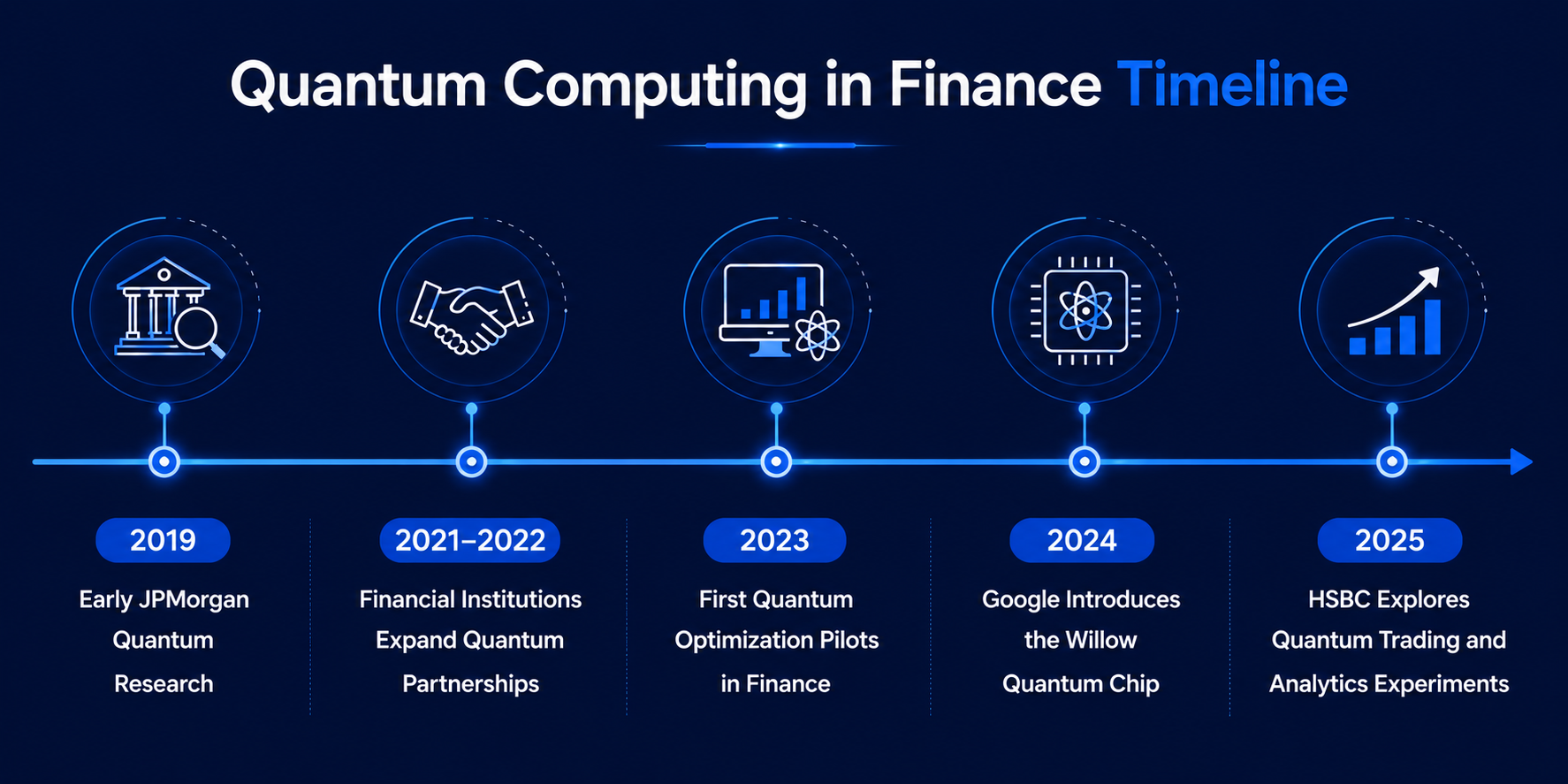
JPMorgan Chase emerged as one of the first major banks to invest heavily in quantum computing research for financial applications. The company explored quantum algorithms for portfolio optimization, derivatives pricing, and risk analysis while collaborating with quantum hardware and software providers. Researchers at JPMorgan also published technical studies examining how quantum systems could eventually improve complex financial simulations. This period marked the beginning of more serious institutional interest in quantum finance research.
Banks and financial firms increasingly partnered with quantum startups, cloud providers, and research institutions to evaluate practical use cases for quantum systems. Companies such as Goldman Sachs, HSBC, and Barclays expanded internal research programs tied to optimization, fraud detection, and financial modeling workloads. During this phase, much of the industry focus shifted toward hybrid quantum-classical approaches rather than fully fault-tolerant quantum computing. Financial institutions also began preparing for the long-term cybersecurity implications of quantum systems.
Financial institutions started testing early quantum optimization pilots connected to portfolio allocation, Monte Carlo simulations, and operational analytics. Although these experiments remained limited by current hardware constraints, they represented an important shift from theoretical exploration toward applied financial experimentation. Several pilot projects focused on determining whether quantum systems could improve computational efficiency for optimization-heavy financial tasks. This period also increased industry attention around NISQ-era quantum hardware and near-term commercial viability.
Google’s Willow quantum chip became part of broader industry discussions around scalable quantum infrastructure and improved qubit stability. Advances in error correction, coherence, and quantum hardware performance renewed interest in how future systems could support large-scale financial computation. Financial institutions closely monitored these developments because hardware progress directly affects the feasibility of real-world quantum finance applications. The conversation around quantum advantage in finance became increasingly tied to hardware scalability rather than theory alone.
In September 2025, HSBC and IBM announced the first-known empirical evidence of quantum value in algorithmic bond trading, reporting up to a 34% improvement in trade-fill prediction over classical methods. The bank explored whether quantum systems could eventually improve computational workloads tied to market analysis, fraud detection, and operational optimization. These initiatives reflected a broader trend of major financial institutions moving beyond purely academic research into controlled experimentation environments. While practical quantum advantage in banking remains a long-term goal, financial firms increasingly view quantum computing as a strategic infrastructure technology for the future.
The prospective intersection of this innovative technology in finance is a topic of conversation among industry leaders, and with good reason.
The potential of quantum computing to bring about significant enhancements in data analysis and financial modeling is an attractive prospect. By leveraging the enormous computational power of quantum machines, financial institutions can potentially manage vast amounts of data with unheard of speed and accuracy. This will, in turn, improve decision-making processes, from risk management to investment strategies.
Quantum algorithms allow for quantum encryption, or quantum key distribution, which could offer near-unbreakable security protocols. This potential improvement could impact online banking and digital payments, where security is of paramount importance.
Investment has continued to climb. According to the Quantum Economic Development Consortium’s State of the Global Quantum Industry 2026 report, the sector drew $56.7 billion in cumulative public funding and $4.9 billion in venture capital by 2025 – a clear signal of how seriously governments and industry now take the technology.
While we are still in the early stages of quantum computing, its potential impact on the finance industry, a realm where quantum computing finance is being closely examined, is immense. It's a thrilling prospect and one that quantum computing platforms like BlueQubit are already contributing to.
Ultimately, quantum finance has the potential to revolutionize financial systems, offering superior computational speed and security. However, it's still in early development stages, with many technical and practical challenges to overcome.
BlueQubit provides an essential stepping-stone by offering a user-friendly interface, fast quantum emulators, QPUs, and seamless integration with open-source libraries like Cirq and Qiskit. The platform offers a real-world glimpse into how quantum computing can enhance industries like finance, but also healthcare and cybersecurity where unhackable data is held in high regard. It essentially puts real quantum hardware at your fingertips, allowing you to use quantum programs through simulators today.
As infrastructure grows to support these new technologies, BlueQubit and other quantum computer software platforms are set to disrupt industries, from finance to healthcare through advanced quantum AI models.
Currently, no banks use a fully realized quantum financial system as it remains largely theoretical. However, several major financial institutions like JPMorgan Chase and Goldman Sachs are actively investing in quantum computing research. Recent experiments, such as HSBC and IBM's 2025 bond-trading trial, show measurable progress, but these remain controlled proofs of concept rather than operational quantum financial systems. This research could potentially pave the way for the future implementation of a quantum financial system. It's important to note that while interest in quantum computing is high, we are yet to see a fully operational quantum financial system in any bank.
The quantum financial system is a term that describes a future system of finance that offers increased security, transparency, and speed. It's a proposed application of the nascent field of quantum computing that shows how the technology could help advance the financial systems of the globe. It should be able to speed up and reinforce financial tasks like risk assessment, financial transactions, investment portfolio management, and more, making it attractive enough that financial system leaders are already investing billions in quantum computing projects.
Quantum theory, or quantum mechanics, is a branch of physics that relates to the behavior of particles at extremely small scales that do not behave in predictable ways. They can exist in multiple states at the same time, known as superposition, and interact with each other non-locally, known as entanglement. By understanding these particles, scientists have started to hone in on ways to utilize these interactions, particularly in the field of computing and therefore finance. Treating these particles as bits (or as they are known in quantum computing, qubits) a computer could theoretically store data multiple times larger and move at speeds multiple times faster, which is an attractive prospect for the financial industry which needs to process huge amounts of data every hour or every day.
The exact timeline for when a fully operational quantum financial system might be implemented is currently unknown. The development of quantum computing, the technology behind this system, is progressing but still faces numerous challenges. It might be years or even decades before we see such a system in action.
Investors interested in quantum computing typically gain exposure through publicly traded technology companies, specialized quantum hardware firms, and emerging quantum-focused investment funds. Companies such as IBM, IonQ, and Quantinuum are among the most visible players in the quantum computing sector today. IBM focuses heavily on superconducting quantum hardware and cloud-based quantum access, IonQ specializes in trapped-ion quantum systems, and Quantinuum develops both quantum hardware and quantum software platforms.
Some investors even look at broader technology and semiconductor companies involved in quantum infrastructure, cloud computing, or AI-driven research. Also, quantum-focused ETFs and emerging technology funds are beginning to provide diversified exposure to companies participating in the quantum ecosystem. Since the industry is still early-stage and highly experimental, many analysts view quantum investing as a long-term, high-risk technology bet rather than a mature market sector.
A “quantum financial system account” is not a recognized banking product or officially deployed financial technology platform today. The phrase is commonly used online in speculative discussions about future financial infrastructure powered by quantum computing, but there is currently no global quantum financial system replacing traditional bank accounts or payment networks.
In practice, quantum computing research in finance is focused on areas such as fraud detection, portfolio optimization, risk analysis, cybersecurity, and financial modeling rather than creating entirely new consumer banking account systems. Claims about an existing “QFS account” or fully operational quantum banking networks should generally be approached with caution, especially when they are tied to conspiracy theories or unsupported financial claims.